The depopulated village of Bayt 'Affa / District of Gaza
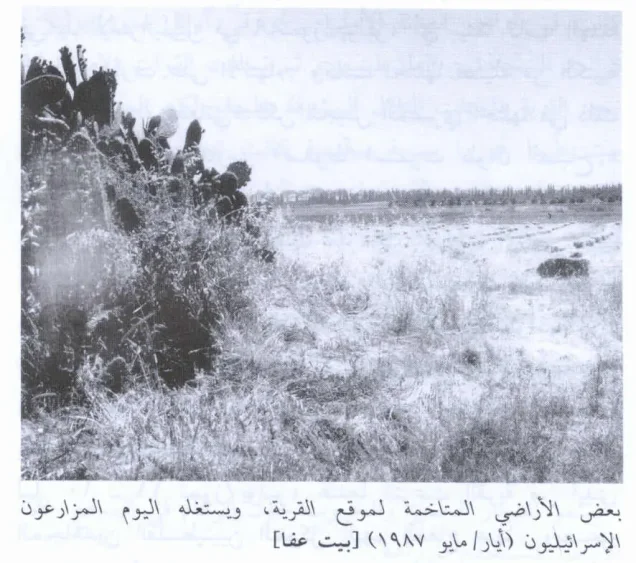
Bayt 'Affa
About the depopulated village of Bayt 'Affa
- District
- Gaza
- Date Bayt 'Affa was occupied
- 09 July 1948
- Population in 1948
- 812
- Military operation
- Operation Yoav
- Brigade that carried it out
- Temporary occupation (July 1948): Givati Brigade; final occupation (October 1948): the unit is not identified in the available sources
- Who defended the village
- Egyptian and Sudanese soldiers
- Distance from the governorate centre
- 29 km northeast of Gaza
- Elevation above sea level
- 100 m
- Cause of displacement
- Direct military assault by Israeli occupation forces; Khalidi considers it likely that the inhabitants were displaced at the time of the first occupation of the village in July 1948
- Extent of destruction
- The village was completely obliterated
- Ethnic cleansing
- Bayt 'Affa inhabitants were completely ethnically cleansed.
- Settlements built on the built-up area of Bayt 'Affa after 1948
- Khalidi lists no settlement on the village's own lands; Yad Natan (1953) was established close to the village site on the land of 'Iraq Suwaydan, northwest of Bayt 'Affa
Hover a dot to read the village name, or click to open its card.
Borders of the depopulated village of Bayt 'Affa
Bayt 'Affa – A Depopulated Palestinian Village in the Gaza Subdistrict
Subdistrict: Gaza
- Subdistrict
- Gaza
- Distance from district center
- 29 km northeast of Gaza
- Average Elevation
- 100 m above sea level
- Population in 1931
- 462
- Number of Houses in 1931
- 105
- Population in 1944/1945
- 700
- Estimated Population in 1948
- About 812 – a later demographic estimate, not an official census
- Total Land Area in 1945
- 5,808 dunams
- Attack and Depopulation
- The village changed hands at least twice: according to the version Khalidi considers more reliable, Givati Brigade forces took it during the Ten Days between the two truces in July 1948 and then lost it to Egyptian forces, the sources' dates for this ranging from 9 to 15 July, and Khalidi considers it likely that its inhabitants were displaced at the time of this first occupation. It was then probably captured by Israeli occupation forces for the last time in the second half of October 1948, during Operation Yoav.
- Final Israeli Control
- Probably the second half of October 1948, during Operation Yoav, according to Khalidi's assessment; the available sources do not give the day of its occupation. It had been temporarily occupied in July 1948: on 9 July, on the night of 10–11 July or on 14–15 July, depending on the source
- Military Operation
- Operation Yoav (final occupation, probably)
- Military Unit
- Temporary occupation in July 1948: the Givati Brigade (a platoon of its Second Battalion according to the History of the War of Independence, units of the brigade according to Morris), whose Fourth Battalion failed to reoccupy the village on 17–18 July; the available sources do not identify the unit that carried out the final occupation in October 1948
- Cause of Depopulation
- Direct military assault by Israeli occupation forces; Khalidi considers it likely that the inhabitants were displaced at the time of the first occupation of the village in July 1948
- Settlements Documented on Village Lands
- Khalidi lists no settlement on the village's own lands; Yad Natan (1953) was established close to the village site on the land of 'Iraq Suwaydan, northwest of Bayt 'Affa
Distance from Gaza: approximately 29 km northeast.
Elevation: approximately 100 metres above sea level.
Population in 1945: 700, all Arab Muslims.
Estimated population in 1948: approximately 812, according to Palestine Remembered.
Date of occupation and depopulation: disputed. The village changed hands more than once in July 1948. Its final Israeli occupation probably took place in the second half of October 1948 during Operation Yoav, while its Palestinian inhabitants were probably displaced during the first Israeli occupation in July.
Military unit: units of the Giv'ati Brigade were involved in the July occupations. The village-specific sources do not conclusively identify the brigade responsible for the final occupation during Operation Yoav.
Israeli settlements established on village land after 1948: Walid Khalidi and PalQuest do not record an Israeli settlement established on Bayt 'Affa's land itself. Yad Natan was established nearby in 1953 on the lands of 'Iraq Suwaydan.
Location of Bayt 'Affa
Bayt 'Affa was a Palestinian village in the Gaza Subdistrict, approximately 29 km northeast of Gaza city and about 100 metres above sea level.
The village stood on a small hill in a slightly elevated area adjoining the coastal plain. Secondary roads connected it with two highways, one running northward and another southward toward al-Majdal and the main coastal highway.
Al-Faluja lay to the southeast, and Bayt 'Affa depended on it for a number of commercial and educational services. 'Iraq Suwaydan and 'Ibdis were also neighbouring villages, while grazing lands used by Bayt 'Affa's inhabitants extended toward Kawkaba to the southwest.
The Name Bayt 'Affa
Palestine Remembered provides an etymological explanation according to which the word “'Affa” is of Syriac origin and is associated both with flowering and with burial or a grave. It therefore proposes the possible meanings “house of flowers” and “house of burial,” favouring the latter because of a shrine in the village that local inhabitants associated with the Prophet Salih.
This proposed etymology does not appear in the Bayt 'Affa entry reproduced by PalQuest from Walid Khalidi's All That Remains. It is therefore presented here as an interpretation reported by Palestine Remembered rather than as a conclusively established origin of the village name.
Historical Background
Bayt 'Affa was once the residence of the Sufi master known as al-Faluji, who migrated from Iraq to Palestine during the fourteenth century before later moving to the place that became known as al-Faluja.
In 1596, Bayt 'Affa was a village in the nahiya of Gaza within the liwa' of Gaza, with an estimated population of 143. Its inhabitants paid taxes on wheat, barley, and fruit, as well as goats, beehives, and vineyards.
By the late nineteenth century, Bayt 'Affa was described as a medium-sized village whose houses were built mainly of adobe brick.
Population of Bayt 'Affa
The inhabitants of Bayt 'Affa were Palestinian Muslims. The official Government of Palestine census of 1922 recorded 422 inhabitants. The population increased to 462 in the 1931 census, living in 105 houses.
The Government of Palestine's 1945 statistics recorded 700 inhabitants, all Arab Muslims.
Population Statistics for Bayt 'Affa
Population of Bayt 'Affa
- 1596143Historical estimate based on Ottoman records
- 1922422Official Mandate census
- 1931462Official Mandate census
- 1945700Government of Palestine statistics
- 1948812Later estimate reported by Palestine Remembered
- Estimated refugees in 19984,987Estimate reported by Palestine Remembered
Number of Houses in Bayt 'Affa
Number of houses in Bayt 'Affa
- 1931105Official census figure
- 1948184Estimate reported by Palestine Remembered
Education in Bayt 'Affa
The reviewed sources do not record a separate school operating in Bayt 'Affa. The village relied partly on neighbouring communities for educational services.
The inhabitants of 'Iraq Suwaydan established a private elementary school in 1942. After 1947, the school was shared with children from neighbouring 'Ibdis and Bayt 'Affa. Enrollment from the three villages totalled 104 pupils in the mid-1940s.
Economic Life in Bayt 'Affa
Most inhabitants depended on rain-fed agriculture, particularly the cultivation of cereals and grapes. Some villagers also raised livestock and grazed their animals on pastureland between Bayt 'Affa and Kawkaba to the southwest.
In 1944/45, 5,657 dunums were allocated to cereals, while 14 dunums were irrigated or used for plantations. A total of 5,671 dunums was classified as cultivable.
The total land area of Bayt 'Affa recorded in the Government of Palestine's Village Statistics was 5,808 dunums.
Land Ownership in Bayt 'Affa in 1945
Land ownership in Bayt 'Affa, 1944/45
- Palestinian / Arab5,707 dunums98%
- Jewish0 dunums0%
- Public101 dunums2%
The official statistics recorded no Jewish-owned land in Bayt 'Affa in 1945.
Land Use in Bayt 'Affa in 1945
Land use in Bayt 'Affa, 1944/45
- Arab / Palestinian (dunums)
- Public (dunums)
- Plantations and irrigable land14 dunums
- Cereals5,657 dunums
- Built-up land26 dunums
- Cultivable land5,671 dunums
- Non-cultivable land111 dunums
The 111 dunums classified as non-cultivable land should not be attributed entirely to Palestinian ownership. They consisted of 10 dunums of Arab land and 101 dunums of public land.
Archaeological Sites
Bayt 'Affa was built on the site of an older settlement. The sources record a shrine and architectural remains east of the village and in Wadi al-Rana.
A khirba on village land contained the remains of walls constructed of uncut stone, as well as a well and columns. Palestine Remembered identifies this site as Khirbat Mamin.
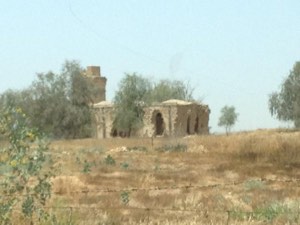
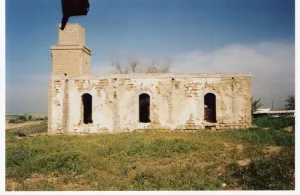
The village also contained a shrine dedicated to a man whom the villagers believed to be the Prophet Salih. This should be understood as a local religious tradition rather than a historically verified identification of the person associated with the shrine.
The January 1948 Attack on Bayt 'Affa
According to a report in the Palestinian newspaper Filastin, reproduced by Walid Khalidi, a unit of Zionist militiamen entered the outskirts of Bayt 'Affa around midnight on 27 January 1948 and attempted to mine several outlying houses.
Village guards detected the raiders and fought them for approximately two hours, forcing the attackers to withdraw toward the settlement of Negba. This attack did not result in the occupation of the village.
Occupation and Depopulation of Bayt 'Affa during the Nakba
The sources provide conflicting accounts of the exact chronology of Bayt 'Affa's occupation during the Nakba and the occupation of Palestine in 1948. The village appears to have changed hands more than once.
Walid Khalidi cites Israeli historian Benny Morris as dating the occupation of Bayt 'Affa by units of the Giv'ati Brigade to 14–15 July 1948, during the Ten Days between the first and second truces.
Another account reproduced by Khalidi states that the village was already held by a platoon of the Giv'ati Brigade's Second Battalion on 9 July, but that the Egyptian army captured it after applying military pressure throughout the morning.
Egyptian writer Muhammad Abd al-Mun'im gives a slightly different chronology, stating that Israeli forces seized the village during the night of 10–11 July and that regular Egyptian forces recaptured it on the morning of 11 July. Another contemporary press account places the first Israeli seizure on 9 July and the Arab recapture on the following day.
The Giv'ati Brigade's Fourth Battalion reportedly attempted to retake Bayt 'Affa on 17–18 July but failed.
Despite these variations, Khalidi considers the account in which Israeli forces captured and then lost Bayt 'Affa during July to be the more credible general sequence. He concludes that the village was probably occupied by Israeli forces for the final time in the second half of October 1948 during Operation Yoav.
Khalidi further considers it probable that Bayt 'Affa's Palestinian inhabitants were displaced during the first Israeli occupation in July rather than during the final occupation in October.
Occupation and Depopulation Chronology
- Midnight, 27 January 1948
First attack on the village
A unit of Zionist militiamen penetrated into the outskirts of the village and tried to mine some of the outlying houses, but village guards detected the raiders and clashed with them for two hours, forcing them to withdraw to the settlement of Negba, according to the Palestinian newspaper Filastin as cited by Khalidi.
- 9 July 1948, the night of 10–11 July, or 14–15 July 1948 (sources differ)
Temporary occupation
According to the History of the War of Independence, the village was held on 9 July by a platoon of the Givati Brigade's Second Battalion, and a New York Times report stated that it was first seized by the Israelis on 9 July, along with 'Iraq Suwaydan and 'Ibdis; Egyptian writer Muhammad Abd al-Mun'im states that it was taken on the night of 10–11 July from the Palestinian militiamen assigned to defend it; Morris dates its capture by Givati Brigade units to 14–15 July, in agreement with a New York Times report dating it to 15 July. Khalidi considers the version according to which the Israelis seized and lost the village during the Ten Days between the two truces to be the more reliable.
- Probably July 1948
Depopulation of the village
Khalidi considers it likely that the villagers were displaced at the time of the first occupation, rather than at the final occupation in October.
- 9, 10 or 11 July 1948 (sources differ)
Recapture of the village by Egyptian forces
According to the History of the War of Independence, the Egyptian army captured the village on 9 July after 'pressure which lasted the whole morning'; according to the New York Times, the Israelis lost it to Arab forces the day after they seized it; Muhammad Abd al-Mun'im states that regular Egyptian forces recaptured it on the morning of 11 July. After that battle, the Israelis claimed to have killed 300 Egyptian and Sudanese soldiers and to have captured 200 others.
- 17–18 July 1948
Failed attempt to reoccupy the village
The Givati Brigade's Fourth Battalion tried and failed to reoccupy the village, although it had the assistance of a naval landing party; the Haganah account cited by Khalidi adds that 'the Egyptians were aware of the vital importance of the village, so they fortified it well.'
- 15 October 1948
Beginning of the military operation
Israeli occupation forces launched Operation Yoav against the Egyptian forces as soon as the second truce ended, with the Givati, Yiftach, Negev and Harel Brigades, opening it with heavy aerial and artillery bombardment; PalQuest lists Bayt 'Affa among the villages affected by the operation.
- Probably the second half of October 1948
Final occupation
Khalidi considers that Israeli occupation forces probably captured the village for the last time in the second half of October, during Operation Yoav; the available sources give neither the day of its occupation nor the unit that carried it out.
Military Operations and Units
Operation Barak should not be identified as the operation in which Bayt 'Affa was occupied. Operation Barak took place in May 1948, whereas the detailed village accounts place the first occupation in July, and Bayt 'Affa does not appear among the villages explicitly listed as affected in PalQuest's Operation Barak entry.
The final occupation is instead considered likely to have taken place during Operation Yoav, which ran from 15 October to 4 November 1948.
Operation Yoav involved the Giv'ati, Yiftach, Negev, and Har'el brigades against Egyptian forces. The village-specific account, however, does not conclusively identify which of these brigades carried out the final occupation of Bayt 'Affa.
- Early attack: 27 January 1948; it did not result in occupation.
- First Israeli occupation: disputed, between 9 and 15 July 1948.
- Unit associated with the July occupations: Giv'ati Brigade, including a platoon of its Second Battalion in one account.
- Arab/Egyptian recapture: during July 1948.
- Probable final Israeli occupation: second half of October 1948.
- Operation associated with the final occupation: Operation Yoav.
- Probable depopulation: during the first Israeli occupation in July 1948.
Fate of the Villagers and Village Buildings
Walid Khalidi considers it probable that Bayt 'Affa's Palestinian inhabitants were expelled during the first Israeli occupation of the village in July 1948. The Palestinian community did not return following the final occupation in October.
The village houses were destroyed after the Nakba. According to the field description used in All That Remains, no traces of the village houses were visible at the site.
Israeli Settlements and Yad Natan
Walid Khalidi's Bayt 'Affa entry and PalQuest do not record an Israeli settlement established on the village's land itself.
Yad Natan was founded close to the village site in 1953, but it was established on the lands of neighbouring 'Iraq Suwaydan, northwest of Bayt 'Affa. It should therefore not be listed as a settlement built on Bayt 'Affa's lands.
Bayt 'Affa Today
The reviewed core sources do not provide a verified recent field survey of Bayt 'Affa as of 2026. Walid Khalidi's documented field description states that no traces of the village houses remained visible and that sycamore and carob trees and cactuses marked the site.
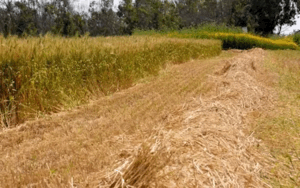
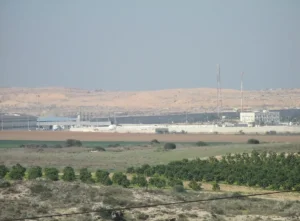
The surrounding lands were planted with fruit trees, especially citrus, and at the time of the field documentation were irrigated with water supplied through a canal connected to water from the Jordan River.
This description reflects conditions at the time of the field research used for All That Remains and should not be treated as a verified on-site description of Bayt 'Affa in 2026 without a newer documented survey.
Sources
- PalQuestPalQuest – Interactive Encyclopedia of the Palestine Question: Bayt 'Affa
- PalQuestPalQuest – 'Iraq Suwaydan: Shared School with Bayt 'Affa and 'Ibdis
- PalQuestPalQuest – Operation Yoav
- PalQuestPalQuest – Operation Barak
- Palestine RememberedPalestine Remembered – Bayt 'Affa, Gaza District
- Institute for Palestine StudiesInstitute for Palestine Studies – Walid Khalidi, All That Remains
- Palestine RememberedGovernment of Palestine – Village Statistics of 1945
Photo gallery


Photos from the village's people
Photos sent in by visitors and published after review.
Add a photo of this village
Log in to add photos of this village.
More from the archive
 Download Our Palestine App
The whole archive in the palm of your hand: depopulated villages, the Nakba, the massacres and Al-Aqsa — free, with no ads to erase the story.
Download Our Palestine App
The whole archive in the palm of your hand: depopulated villages, the Nakba, the massacres and Al-Aqsa — free, with no ads to erase the story.

Comments
No comments yet — be the first to write one.
Add your comment
Name and email are optional. Comments appear after review.