
Herbert Samuel’s Secret Memorandum “The Future of Palestine” to the British Government
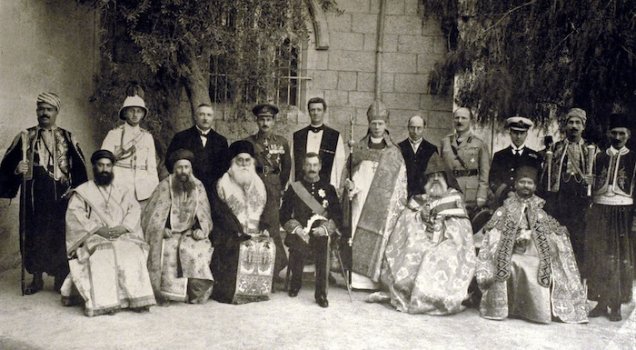
Herbert Samuel’s Secret Memorandum “The Future of Palestine” to the British Government
In early 1915, during the First World War, British politician Herbert Samuel, a Jewish member of the British Cabinet who had become sympathetic to Zionism, prepared a confidential memorandum entitled “The Future of Palestine”.
An initial version of the memorandum was circulated in January 1915, followed by a revised version prepared by Samuel in March 1915. The document was written at a time when Britain and the other Allied powers were already discussing the future of the territories of the Ottoman Empire and how influence over them might be divided in the event of its defeat in the war.
Samuel’s memorandum was among the earliest high-level documents produced within the British government to connect British imperial interests in Palestine with the aspirations of the Zionist movement.
The document is particularly significant because it reveals that Palestine’s political and demographic future was already being discussed within British governing circles years before the Balfour Declaration, without the Palestinian people participating in decisions concerning the future of their own country.
The Proposals of “The Future of Palestine”
Samuel considered several possible arrangements for the future of Palestine following the anticipated defeat of the Ottoman Empire, including placing Palestine under French control, establishing an international administration, maintaining Ottoman rule with new guarantees, or incorporating it into Egypt.
His preferred option, however, was for Palestine to come under direct British control and to be annexed to the British Empire.
Samuel believed that such an arrangement could serve British imperial interests while at the same time providing a suitable political framework for the objectives of the Zionist movement. He wrote that the solution that would be most welcomed by Zionist leaders and their supporters around the world was:
“the annexation of the country to the British Empire.”
Samuel proposed that under British rule, Jewish organizations should be given opportunities to purchase land, establish colonies, create educational and religious institutions, and contribute to what he described as the economic development of Palestine.
He also advocated preferential treatment for organized Jewish immigration. His memorandum envisioned a gradual process in which the Jewish population would increase until it became a majority in the country, after which, in his view, a degree of self-government could be granted according to the circumstances prevailing at the time.
Samuel therefore did not propose the immediate establishment of an independent Jewish state. He acknowledged that Jews were still a minority of Palestine’s population and warned that immediately placing the Arab majority under a government dependent on a much smaller Jewish minority could lead to unrest and internal confrontation.
The alternative he proposed was gradual: the British Empire would assume political control over Palestine, while that control would provide the framework within which Jewish immigration, land acquisition, settlement, and institution-building could expand over an extended period.
Palestine in Samuel’s Imperial Vision
The memorandum did not present British control of Palestine merely as support for the Zionist movement. Samuel also linked it directly to British strategic interests.
Palestine’s geographical position held particular importance in his vision because of its proximity to Egypt and the Suez Canal, one of the most important arteries of the British Empire and a vital route connecting Britain with India and its other possessions in Asia.
Samuel argued that British control of Palestine would strengthen the defense of Egypt and the Suez Canal and prevent a rival major European power from establishing itself near Egypt’s eastern frontier.
He wrote that the presence of a hostile European power in southern Palestine could pose a military threat to the Suez Canal, whereas Palestine under British control could serve as an advanced position for the defense of Egypt and British imperial interests.
The memorandum was also written in language that clearly reflected the prevailing European colonial thought of the period. Samuel presented Britain as a power capable of “civilizing” a country he described as backward, and portrayed the local Palestinian society through paternalistic and colonial assumptions common in European imperial discourse.
From a Palestinian perspective, this language reveals the underlying framework of the memorandum: Palestine was treated primarily as a territory whose future could be determined according to British strategic calculations and Zionist aspirations, rather than as the homeland of a people entitled to determine their own political future.
Jewish Immigration and the Creation of a Future Majority
One of the most significant and consequential passages in Samuel’s memorandum concerned demographic change in Palestine.
He proposed facilitating Jewish immigration under British rule and granting it organized preferential treatment, so that the Jewish population would gradually increase until it became a stable majority in the country. Once that stage had been reached, he believed that circumstances might permit granting this majority a degree of self-government.
This was not merely a proposal to provide refuge for individual immigrants, but a vision of a political process linking immigration, land acquisition, the establishment of colonies, demographic growth, British protection, and future self-government.
This idea carries particular historical weight in the Palestinian reading of the memorandum. Palestinian Arabs constituted the clear majority of the country’s population, while Samuel’s proposal envisioned gradually transforming this demographic balance through immigration encouraged and protected by a foreign imperial power.
Samuel was explicit on this point, writing that Jewish immigration should receive preferential treatment “until, in the course of time, the Jewish people, grown into a majority and settled in the land,” could then be considered for a degree of self-government.
An Early Precursor to the Balfour Declaration
“The Future of Palestine” was not in itself official British policy, nor did every member of the British government support all of Samuel’s proposals. Prime Minister Herbert Henry Asquith (H. H. Asquith), for example, responded to the proposals with clear skepticism and recorded in his diary his objection to the idea of annexing Palestine and transforming it into a center for millions of Jewish immigrants.
Nevertheless, the memorandum represented an important early stage in introducing the idea of British sponsorship of the Zionist project in Palestine into discussions at the highest levels of government.
Approximately two years later, on November 2, 1917, Britain issued the Balfour Declaration, announcing that the British government viewed with favor the establishment in Palestine of a “national home for the Jewish people.”
Samuel’s memorandum should therefore be understood as one of the important political precursors to the Balfour Declaration rather than as its sole source. It anticipated several ideas that later became key elements of British policy toward Palestine: British control over the country, support for Zionist settlement, facilitation of Jewish immigration, and the construction of institutions necessary to establish an organized Jewish national presence there.
Herbert Samuel as High Commissioner for Palestine
The historical significance of the memorandum increased when Herbert Samuel was appointed in 1920 as Britain’s first civilian High Commissioner for Palestine, a position he held until 1925.
His appointment came before the League of Nations formally approved the British Mandate for Palestine. Samuel assumed office on July 1, 1920, at a time when Britain had already begun establishing a new civil administration in the country.
During the first months of this administration, the first immigration regulations were issued in August 1920, creating a new legal framework regulating the entry of immigrants into Palestine and opening the way for continued Jewish immigration under British authority.
In the years that followed, Zionist political, economic, and social institutions were able to expand under British rule, while Palestinian opposition to Zionism and demands for representative government and the right to self-determination repeatedly came into conflict with British policy in the country.
From “The Future of Palestine” Memorandum to the Nakba
The Palestinian Nakba cannot be reduced to a single memorandum written more than three decades earlier, nor can all subsequent developments be regarded as a literal implementation of Samuel’s proposals. The document nevertheless reveals an early political vision linking British control over Palestine with the encouragement of Jewish immigration, land acquisition, the establishment of colonies, and gradual demographic transformation.
During the following decades, Palestine under British occupation and later the Mandate became a framework within which Zionist institutions, immigration, and settlement expanded, while Palestinians continued to demand independence and the right to self-determination and to resist the transfer of their land and policies that threatened their national future.
Between 1947 and 1949, the Zionist project entered a decisive phase marked by the occupation of large parts of Palestine and the Palestinian Nakba. Around three-quarters of a million Palestinians were displaced from their towns and villages, hundreds of Palestinian communities were destroyed or emptied of their inhabitants, and the State of Israel was established in 1948 over most of Mandatory Palestine.
More from the archive


 Download Our Palestine App
The whole archive in the palm of your hand: depopulated villages, the Nakba, the massacres and Al-Aqsa — free, with no ads to erase the story.
Download Our Palestine App
The whole archive in the palm of your hand: depopulated villages, the Nakba, the massacres and Al-Aqsa — free, with no ads to erase the story.

Comments
No comments yet — be the first to write one.
Add your comment
Name and email are optional. Comments appear after review.