The depopulated village of Qazaza / District of Ramla
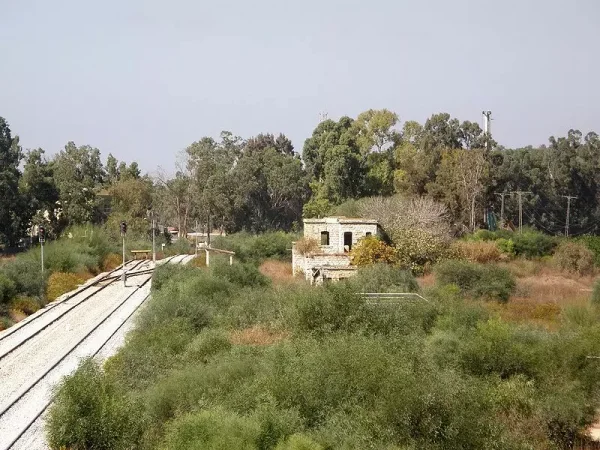
About the depopulated village of Qazaza
- District
- Ramla
- Date Qazaza was occupied
- 09 July 1948
- Population in 1948
- 1,090
- Military operation
- Operation An-Far
- Brigade that carried it out
- Givati Brigade
- Who defended the village
- Egyptian Army, and some local Palestinian militia.
- Distance from the governorate centre
- 19 (km) South of al-Ramla
- Elevation above sea level
- 150 m
- Cause of displacement
- Influence of fall of, or exoduce from, neighboring town
- Extent of destruction
- Since the Israeli Army currently uses Qazaz's lands, it is hard to tell whether Qazzaza was destroyed or not!
- Ethnic cleansing
- Qazaza inhabitants were completely ethnically cleansed.
- Refugees' migration routes
- People of Qazaza were most likely displaced to the Hebron area.
Hover a dot to read the village name, or click to open its card.
Borders of the depopulated village of Qazaza
Qazaza: A Depopulated Palestinian Village in the Ramla District
Qazaza was a Palestinian village in the Ramla District, located approximately 19 km south of Ramla in hilly terrain on the eastern edge of the central coastal plain, at an average elevation of about 150 metres above sea level. The village was attacked by Zionist forces as early as December 1947 and was invaded by units of the Giv'ati Brigade on 9–10 July 1948 during Operation An-Far. Its Palestinian inhabitants were displaced during the Nakba and the occupation of Palestine in 1948.
Location of Qazaza
Qazaza stood in a hilly area along the eastern edge of the central coastal plain.
The village was approximately 19 km south of Ramla and had an average elevation of about 150 metres above sea level.
Two secondary roads connected it with the highway running between Gaza and the Ramla–Jerusalem road.
One of these roads also led to the Wadi al-Sarar railway station on the Ramla–Jerusalem line, approximately 3 km due north of the village.
Neighbouring Palestinian villages included Sajad, Jilya, Umm Kalkha, al-Mukhayzin, Mughallis, and al-Burayj.
Qazaza before the Nakba
A European traveller reported passing through Qazaza in the 1860s while travelling to examine a nearby tell.
The village had a rectangular layout extending along a north–south axis and was divided into a northern section, a middle section that formed the oldest part of the village, and a southern section.
The houses were clustered closely together and were constructed of cement, stone, and mud.
The inhabitants were predominantly Muslim. Qazaza had a mosque, and some villagers operated small shops.
Education in Qazaza
An elementary school was established in Qazaza in 1922.
In 1945, the inhabitants of Qazaza, Sajad, and Jilya established a shared school serving the three villages. It had 127 pupils when it was founded.
The figure of 127 therefore refers to the joint school rather than to pupils from Qazaza alone.
Economic Life in Qazaza
The village economy depended primarily on rainfed agriculture.
The villagers cultivated cereals, vegetables, and fruit, while a smaller area was devoted to irrigated agriculture and plantations.
According to the 1944/45 statistics, a total of 15,684 dunums was devoted to cereals: 11,757 Palestinian dunums and 3,927 communal/public dunums.
Another 131 Palestinian dunums were irrigated or used for plantations.
Palestine Remembered records 13 dunums planted with olive trees. This olive area forms part of the agricultural and plantation figures and should not be added again to the total cultivable land.
Land Ownership in Qazaza
The total registered land area of Qazaza was 18,829 dunums in the 1944/45 statistics.
Land ownership in Qazaza, 1944/45, using the terminology of Palestine Remembered
- Palestinian14,272 dunums76%
- Transferred to Zionists0 dunums0%
- Communal4,557 dunums24%
No land was recorded under the category “Transferred to Zionists” in the 1944/45 ownership data.
Land Use in Qazaza, 1944/45
Land use in Qazaza, separating ownership categories according to PalQuest's detailed statistics
- Palestinian
- Communal/Public
- Plantations and irrigable land131 dunums
- Cereals15,684 dunums
- Built-up area38 dunums
- Non-cultivable land2,976 dunums
A total of 15,815 dunums, approximately 84 percent of Qazaza's lands, was cultivated or cultivable: 11,888 Palestinian dunums and 3,927 communal/public dunums.
Built-up and non-cultivable land together amounted to 3,014 dunums, or about 16 percent of the total.
Palestine Remembered presents all 15,684 dunums of cereal land in a single Palestinian column, whereas PalQuest's detailed statistics separate that figure into 11,757 Arab dunums and 3,927 public dunums.
Likewise, Palestine Remembered presents 2,976 dunums of non-arable land in the same column, while PalQuest separates this into 2,347 Arab dunums and 629 public dunums. The communal/public category is therefore shown separately here.
Population of Qazaza
Population of Qazaza in selected years
- 1922472Official British Mandate census
- 1931649Official British Mandate census
- 1944/45940Official statistics; all recorded inhabitants were Arab
- 19481,090Later estimate published by Palestine Remembered
- Estimated refugees in 19986,696Later estimate published by Palestine Remembered
Number of Houses in Qazaza
Number of houses in Qazaza
- 1931150Official British Mandate census figure
- 1948251Later estimate published by Palestine Remembered
Archaeological and Older Sites around Qazaza
The principal sources mention a tell near Qazaza that a European traveller visited in the 1860s, but Khalidi's PalQuest entry does not provide enough archaeological detail to establish a specific historical identification.
No particular archaeological period or settlement is therefore attributed to the village without stronger documentation from the approved sources.
The Attack on Qazaza, 20 December 1947
The first documented attack on Qazaza occurred in the early hours of 20 December 1947.
According to press reports reproduced by Walid Khalidi, a group of Zionist attackers approached the village shortly after midnight and opened fire.
The firing continued intermittently for about three hours and was followed by a barrage of hand grenades.
The New York Times reported that the mukhtar's house was also blown up, while the Palestinian newspaper Filastin stated that villagers returned fire.
British police estimated that one villager was killed and two others were wounded, including a woman. Police attempted to pursue the attackers but were unable to locate them.
Operation An-Far and the Occupation of Qazaza
Qazaza's final occupation occurred at the end of the first truce during Operation An-Far, an offensive conducted by the Giv'ati Brigade on the southern front between 8 and 15 July 1948.
Operation An-Far was launched during the “Ten Days” between the two truces and sought to expand Giv'ati's area of control eastward and southward while attempting to establish a link between the occupied coastal area and Jewish settlements in the Negev.
PalQuest states that the operation was carried out by the First Battalion of the Giv'ati Brigade and that the battalion's orders included the expulsion of civilians from areas it occupied.
Although Egyptian forces partially blocked the offensive, Operation An-Far displaced the populations of approximately sixteen villages near the junction of the Gaza, Hebron, and Ramla districts and uprooted more than twenty thousand Palestinians from the wider area.
Occupation and Depopulation of Qazaza during the Nakba
Walid Khalidi and PalQuest place the invasion of Qazaza by Giv'ati units on 9–10 July 1948 during Operation An-Far.
Palestine Remembered gives 9 July 1948 as the occupation date and identifies the First Battalion of the Giv'ati Brigade as the unit responsible.
Khalidi reproduces Israeli accounts claiming that villagers left as Israeli columns approached, but those sources are not used independently here. PalQuest's dedicated account of Operation An-Far, meanwhile, explicitly states that the First Battalion's orders included expelling civilians from the occupied area.
Khalidi considers it most likely that the inhabitants of Qazaza, like other displaced villagers in the area, were driven or fled toward the Hebron region.
- Occupation date according to Palestine Remembered: 9 July 1948.
- Period given by Khalidi/PalQuest: 9–10 July 1948.
- Military operation: Operation An-Far.
- Attacking unit: First Battalion of the Giv'ati Brigade.
- Arab force opposing the operation in the region: Egyptian forces.
- Fate of the inhabitants: the villagers were displaced during the Nakba, most probably toward the Hebron region.
The principal approved sources used here do not provide sufficient evidence to establish that a massacre occurred in Qazaza during its July occupation. No such claim is therefore presented as confirmed fact.
Settlements on the Lands of Qazaza
Walid Khalidi and PalQuest do not identify a civilian Israeli settlement established directly on Qazaza's village lands after the Nakba.
Tirosh, established in 1955 near the site, was built on land belonging to the depopulated Palestinian village of 'Ajjur in the Hebron District, not on Qazaza's lands.
The Qazaza site itself was used as a fenced military base.
Qazaza Today
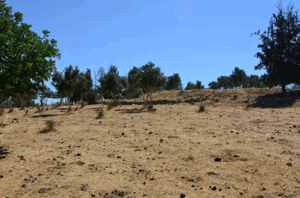
According to the field description published by Walid Khalidi in All That Remains, the Qazaza site lay inside a closed military area and the site itself was a fenced military base to which access was prohibited.
Because of this restricted access, Khalidi's entry does not provide the type of detailed description of surviving houses and village remains available for many other depopulated villages.
This principal description derives from field research published in Khalidi's 1992 volume. Palestine Remembered also contains a pre-Nakba aerial photograph, oral-history material, maps, and later community contributions, but these do not constitute a comprehensive, independent contemporary field survey inside the site.
The approved sources used here therefore do not provide a sufficiently recent and independent field verification to confirm the precise condition of every part of Qazaza in 2026, particularly given the site's status as a closed military area in the latest systematic field description relied upon here.
Sources
- PalQuestPalQuest – Interactive Encyclopedia of the Palestine Question: Qazaza
- PalQuestPalQuest – Operation An-Far
- Palestine RememberedPalestine Remembered – Qazaza, Ramla District
- Palestine RememberedPalestine Remembered – Qazaza entry from All That Remains
- Institute for Palestine StudiesInstitute for Palestine Studies – All That Remains, Walid Khalidi
Photos from the village's people
Photos sent in by visitors and published after review.
Add a photo of this village
Log in to add photos of this village.
Other villages from Ramla
More from the archive
 Download Our Palestine App
The whole archive in the palm of your hand: depopulated villages, the Nakba, the massacres and Al-Aqsa — free, with no ads to erase the story.
Download Our Palestine App
The whole archive in the palm of your hand: depopulated villages, the Nakba, the massacres and Al-Aqsa — free, with no ads to erase the story.
Comments
No comments yet — be the first to write one.
Add your comment
Name and email are optional. Comments appear after review.