The Eilabun Massacre, 1948: Executions, Expulsion and a Rare Return
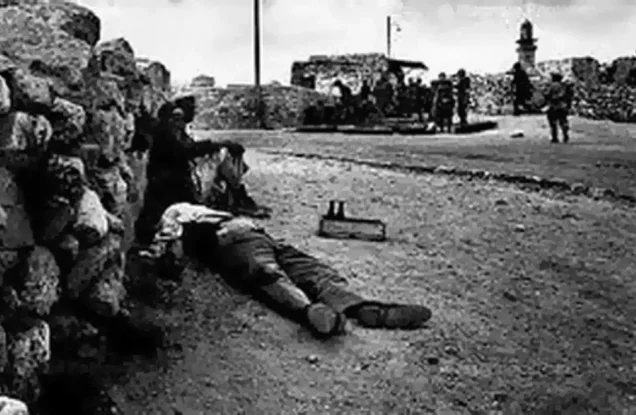
On the morning of 30 October 1948, Zionist forces entered the village of Eilabun in the Galilee and executed 12 of its finest young men in the village streets, bringing the death toll to 14, then drove its people out towards Lebanon. But Eilabun is one of the few villages whose people returned. They buried their martyrs, rebuilt their village, and still tell its story today.
The Village of Eilabun
Eilabun is a Palestinian village in the Lower Galilee, northwest of Lake Tiberias, and most of its people are Christians. In October 1948 it lay in the path of Operation Hiram, the Israeli army's campaign to occupy the Galilee.
The Capture of the Village
The 12th Battalion of the Golani Brigade captured the village on 30 October, after a battle on its outskirts with the Arab Liberation Army. The villagers took refuge in the village churches, raised white flags and declared their surrender, hoping to remain safe in their village.
But the soldiers forced the residents out of the churches and fired shots to terrorise them and force them to gather in the village square. One villager was killed and another wounded as they were being gathered.
The Executions
In the square, the soldiers picked out 18 of the village's finest young men. They took 6 of them as human shields and forced them to drive a military vehicle at the head of the army. These six later managed to escape and survived. The remaining 12 young men were executed by firing squad, three at a time in different places in the village.
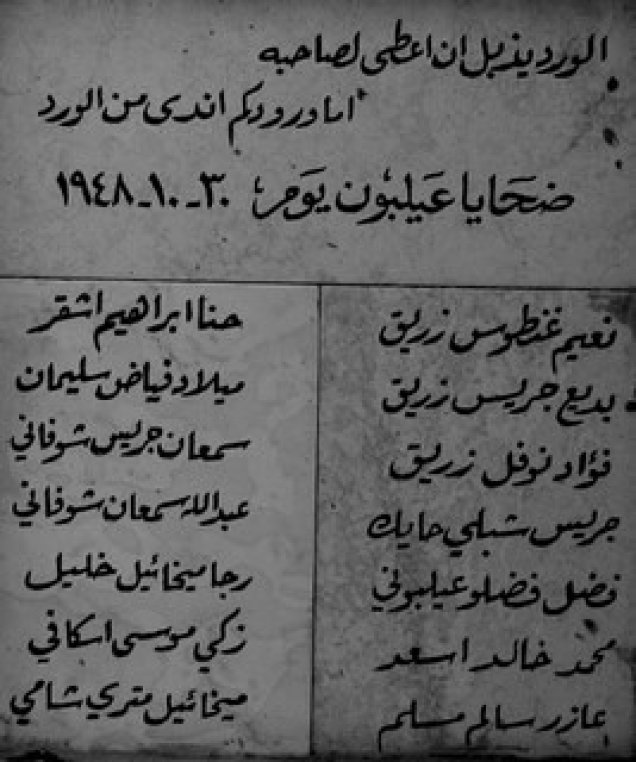
These are the names of the martyrs and the places where they were executed:
- Near the Umm al-Dhib taboon gate beside the village square: Naim Ghantous Zreiq, Hanna Ibrahim Ashqar, and Muhammad Khaled As'ad, who had taken refuge in Eilabun after the fall of Hittin.
- In the street: Milad Fayyad Suleiman, Fadl Fadlo Eilabouni, and Zaki Musa Skafi.
- Near the village cemetery: Abdallah Sim'an Shoufani, Mikhail Mitri Shami, and Raja Mikhail Khalil.
- In the square: Badi' Jiryis Zreiq, Fuad Nawfal Zreiq, and Jiryis Shibli Hayek.
Expulsion to Lebanon
After the executions, soldiers drove about 800 villagers towards Maghar, then Farradiya, then Meiron, and on to the Lebanese border, with gunfire behind them. Many were wounded, and Sim'an Jiryis Shoufani, aged 60, was killed, bringing the number of martyrs to 14. Along the way, soldiers robbed the villagers of their money and the women of their jewellery, and took dozens of young men to detention camps.
The refugees reached Lebanon and settled in Mieh Mieh refugee camp near Sidon, living in tents alongside other Palestinian refugees in the harshest conditions.
The Return to Eilabun
The people of Eilabun did not accept their expulsion. Those who remained near the village, and the priests who stayed in it, demanded that the villagers be allowed back. The church and the United Nations intervened, and in the summer of 1949 the Israeli authorities agreed to the refugees' return under an agreement with Archbishop George Hakim.
A messenger from the village was sent to Lebanon to find Eilabun's refugees and tell them of the decision, and a journey of return began that lasted months. Some returnees were arrested and deported, but hundreds reached their village and found it looted and empty. They buried their martyrs, rebuilt the village and started life again.
Eilabun remains a witness that return is possible, and that those who return to their land bring it back to life.
Frequently Asked Questions About the Eilabun Massacre
When did the Eilabun massacre take place?
On 30 October 1948, during Operation Hiram to occupy the Galilee.
How many were killed in the Eilabun massacre?
14 martyrs: 12 young men executed in the village streets, one villager killed while the residents were being gathered, and Sim'an Shoufani, killed on the road of expulsion.
Who carried out the Eilabun massacre?
The 12th Battalion of the Golani Brigade of the Israeli army.
Did the people of Eilabun return to their village?
Yes. Hundreds returned from Lebanon in 1949 after intervention by the church and the United Nations, and rebuilt the village. It is one of the few villages whose people returned after being expelled.
Read more:
Photo gallery
More from the archive
 Download Our Palestine App
The whole archive in the palm of your hand: depopulated villages, the Nakba, the massacres and Al-Aqsa — free, with no ads to erase the story.
Download Our Palestine App
The whole archive in the palm of your hand: depopulated villages, the Nakba, the massacres and Al-Aqsa — free, with no ads to erase the story.
Comments
No comments yet — be the first to write one.
Add your comment
Name and email are optional. Comments appear after review.