The al-Buraq Uprising of 1929: Jerusalem and Palestinian Resistance Under the British Mandate
The al-Buraq Uprising of 1929: Jerusalem and Palestinian Resistance Under the British Mandate
The al-Buraq Uprising of 1929 was one of the earliest major Palestinian uprisings to spread across large parts of the country during the British Mandate period. It marked a pivotal stage in the confrontation between the Palestinian national movement, British colonial rule, and the expanding Zionist project in Palestine.
The immediate crisis centered on the al-Buraq Wall, the western section of the outer wall of al-Haram al-Sharif in Jerusalem, known to Jews as the Western Wall or Wailing Wall. Tensions surrounding the site escalated sharply during August 1929 and subsequently developed into widespread confrontations across Palestine.
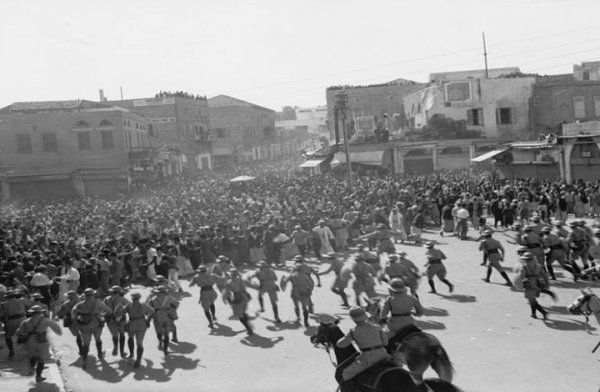
The escalation intensified on August 15, 1929, when a large Zionist demonstration, partly led by members of the Revisionist Zionist youth movement Betar, marched toward the al-Buraq Wall. The following day, Palestinians organized a counter-demonstration after Friday prayers at al-Haram al-Sharif.
During the following week, tensions escalated into widespread confrontations. By August 23, the events had entered a more serious phase in Jerusalem and then spread to different towns and villages across Palestine, including Hebron, Safad, and other areas.
Palestinians remember these events as the “al-Buraq Uprising”, while British official documents generally used terms such as the “Western Wall Disturbances” or the “Disturbances of August 1929.”
What Is the al-Buraq Wall?
The al-Buraq Wall forms part of the western outer wall of al-Haram al-Sharif, the sacred compound that includes al-Aqsa Mosque and the Dome of the Rock.
For Muslims, the Wall is associated with the Islamic account of the Prophet Muhammad’s Night Journey and Ascension and with al-Buraq, upon which the Prophet Muhammad, peace be upon him, was carried during the Night Journey. This is the origin of its Arabic name. For Jews, the same Wall is a sacred place of prayer associated with the ancient Jewish Temple.
Under Ottoman rule, Jews were permitted to approach the Wall and pray there, while the Wall itself, the pavement in front of it, and the adjacent Maghrabi Quarter were regarded as Muslim waqf property.
The Ottoman authorities generally maintained a status quo that allowed Jewish worship at the site while restricting changes or additions that could be interpreted as establishing ownership or permanent control over it.
After Britain occupied Jerusalem and imposed the Mandate over Palestine, the British authorities declared that they would preserve this status quo. During the 1920s, however, disputes intensified over attempts to introduce new religious furnishings and practices at the site and over competing claims regarding the future of the Wall and the rights of the different parties there.
For Palestinians, these developments were increasingly understood not as an isolated religious dispute, but as part of a broader political context involving Jerusalem, Zionist settlement, immigration, land acquisition, and the future sovereignty of Palestine.
The Spark of the al-Buraq Uprising
On August 15, 1929, which coincided with a Jewish commemoration of the destruction of the ancient Temple, a Zionist demonstration marched through Jerusalem toward the al-Buraq Wall.
Participants included supporters of the Revisionist Zionist movement and members of Betar. The demonstrators raised the Zionist flag, sang the Zionist anthem, and chanted slogans asserting Jewish claims to the Wall.
The demonstration provoked a strong reaction among Palestinians at a time when fears were already growing over attempts to alter the established status quo at the site and over the possibility that such steps could serve as a prelude to extending Zionist control over the Wall and the surrounding area of al-Haram al-Sharif.
On August 16, a Friday that also coincided that year with the celebration of the Prophet Muhammad’s birthday, a large Palestinian demonstration emerged from al-Haram al-Sharif and moved toward the al-Buraq Wall.
During the demonstration, some objects used by Jewish worshippers were damaged, and prayer papers placed in the cracks of the Wall were removed and burned.
Tensions continued to rise during the following days amid confrontations, rumors, inflammatory publications, and religious fears, alongside the broader political context of Zionist immigration, land acquisition, and the future of Palestine.
From Jerusalem to the Rest of Palestine
By August 23, 1929, the crisis had erupted into widespread confrontations in Jerusalem and then spread to many other parts of Palestine.
Clashes and attacks extended from Hebron and the southern districts to Safad in the north, as well as to Jerusalem and other towns, villages, and Jewish settlements.
Palestinians suffered heavy casualties during the confrontations and as a result of the intervention of British forces and security services, which deployed troops, armored vehicles, and other means to bring the events under control.
The confrontations continued for several days until British forces succeeded in reimposing control.
The Shaw Commission and the Causes of the al-Buraq Uprising
Following the events, the British government established a commission of inquiry headed by Sir Walter Shaw to investigate the causes of the confrontations.
The Shaw Commission issued its report in March 1930.
The Commission concluded that the outbreak of widespread violence in Jerusalem on August 23 began with attacks by Palestinian Arabs against Jews and that the events had not been planned in advance.
However, the Commission did not limit its explanation to the immediate events. It also identified deeper political and economic causes underlying the tension.
It concluded that the fundamental source of hostility among Palestinian Arabs was their frustration at the failure to fulfill their political and national aspirations and their fear that continued Jewish immigration and land acquisition could deprive them of their livelihoods and ultimately place them under Jewish political domination.
The Shaw Commission also considered the Zionist demonstration at the al-Buraq Wall on August 15, among the series of incidents preceding the confrontations, to have been the event that contributed most directly to the outbreak of the crisis.
These findings were particularly significant because they showed that an official British inquiry acknowledged that the events could not be reduced to a religious dispute over a sacred site. Behind them lay a broader political question involving immigration, land, national rights, and the political future of Palestine.
The International Commission on the al-Buraq Wall
The Shaw Commission itself did not determine the question of ownership of the al-Buraq Wall.
Instead, it recommended establishing a separate commission to determine the competing rights and claims concerning the site.
In January 1930, the Council of the League of Nations approved the establishment of an international commission composed of three non-British members.
The commission was chaired by former Swedish Foreign Minister Eliel Löfgren, with Swiss jurist Charles Barde and Dutch statesman C. J. van Kempen serving as its other members.
After examining historical records, legal documents, waqf records, testimony, and arguments submitted by Muslim and Jewish representatives, the commission issued its findings in December 1930.
The commission concluded that:
- Sole ownership and proprietary rights over the al-Buraq Wall belonged to the Muslims, because it formed an integral part of the waqf of al-Haram al-Sharif.
- The pavement in front of the Wall was also Muslim property.
- The adjacent Maghrabi Quarter was Muslim waqf property.
- Jewish worshippers retained an established right of access to the Wall for devotional purposes.
- Jewish religious practices at the site were subject to regulations preserving the established status quo and could not establish proprietary rights over the Wall or the adjacent pavement.
The ruling thus distinguished between ownership and the right of religious access: it confirmed Muslim ownership of the Wall and its immediate surroundings while preserving the established Jewish right to access the site and pray there.
Casualties and British Repression
According to official figures, the events resulted in the deaths of 133 Jews and 116 Palestinian Arabs.
A further 339 Jews and 232 Palestinians were wounded.
In the aftermath of the events, the British authorities arrested approximately 1,300 people, most of them Palestinians, and imposed an extensive series of trials and judicial and collective punishments.
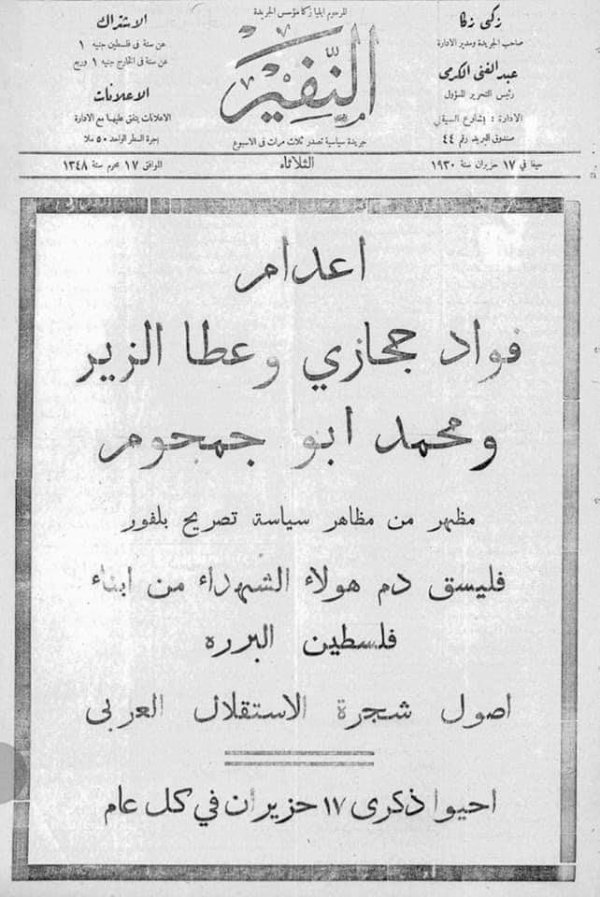
Numerous death sentences were issued in connection with the uprising. Most were later commuted, but the British Mandate authorities carried out the executions of three Palestinians:
- Fouad Hijazi of Safad.
- Muhammad Jamjoum of Hebron.
- Atta al-Zeer of Hebron.
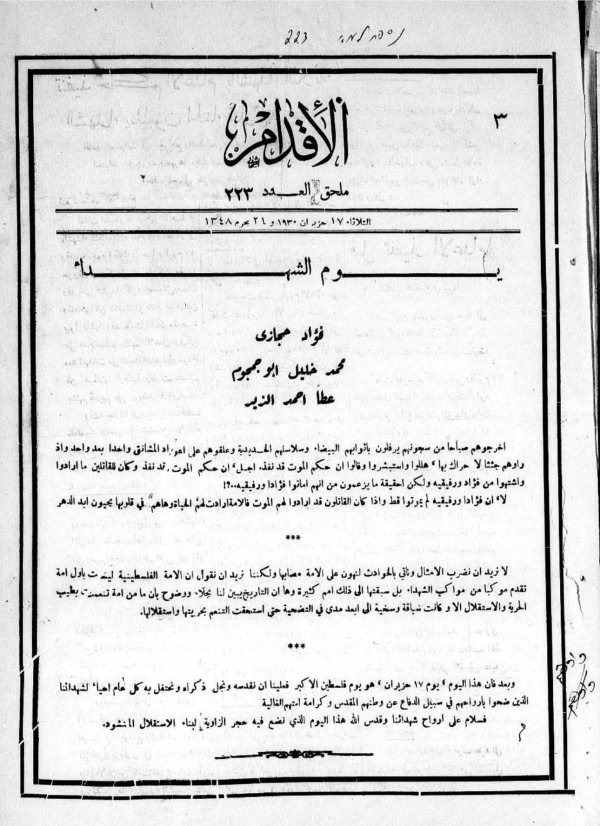
The three men were hanged in Acre Prison on June 17, 1930.
Their execution became one of the most enduring symbols of Palestinian resistance during the British Mandate. The day became known in Palestinian memory as “Red Tuesday”, and Palestinian poet Ibrahim Tuqan immortalized it in his poem of the same name.
Jamjoum, Hijazi, and al-Zeer were also commemorated in Palestinian popular culture through poetry and national songs, most notably in the song associated with the words “From Acre Prison Came a Funeral Procession.”
A Jewish defendant was also sentenced to death in one of the cases connected to the events, but the sentence was later commuted.
The al-Buraq Uprising and the Development of Palestinian National Consciousness
The al-Buraq Uprising was not the first Palestinian protest or armed confrontation of the British Mandate period. It had been preceded by demonstrations, political campaigns, and confrontations, including the events of 1920 and 1921.
Nevertheless, the events of 1929 represented an important turning point because of their geographical scope, the number of people involved, the scale of the casualties, and the way in which the defense of Jerusalem’s holy places became linked to the broader Palestinian struggle over land, immigration, political rights, and national sovereignty.
In the aftermath of the uprising, debate intensified within the Palestinian press over the symbols and institutions of an independent Palestinian national identity, including proposals for a Palestinian national flag and national anthem.
The uprising also contributed to the growth of Palestinian women’s political activism. Only about two months later, Palestinian women from across the country gathered in Jerusalem for the First Palestine Arab Women’s Congress on October 26, 1929.
The Congress called for the abolition of the Balfour Declaration, an end to Zionist immigration, support for Palestinian independence, and the organization of the Palestinian women’s movement on a nationwide basis, marking a major stage in the emergence of an organized Palestinian women’s political movement.
The Historical Significance of the al-Buraq Uprising
From a Palestinian historical perspective, the al-Buraq Uprising demonstrated that the question of Jerusalem could not be separated from the broader political question concerning the future of Palestine.
What began as a dispute over rights and practices at a sacred site became connected to deeper Palestinian fears over the consequences of Zionist immigration, land acquisition, British support for the establishment of the “Jewish national home,” and the denial of the Palestinian right to national self-determination.
The events also increasingly revealed the central role of the British Mandate authorities. Britain was not merely a power separating two communities in confrontation; it governed Palestine under a Mandate that explicitly obligated it to facilitate the establishment of the “Jewish national home,” while Palestinian demands for independence and representative government remained unfulfilled.
The al-Buraq Uprising therefore represented an important stage in the development of modern Palestinian national consciousness and in the course of Palestinian resistance to British colonial rule and the Zionist project.
Less than a decade later, the confrontation between Palestinian demands for independence, British colonial rule, and Zionist settlement erupted on a much larger scale during the Great Palestinian Revolt of 1936–1939.
In Palestinian collective memory, the events of 1929 have remained closely associated with the defense of Jerusalem, al-Aqsa Mosque, and the al-Buraq Wall, as well as with the broader struggle to protect Palestinian land, political rights, and national identity.
Photo gallery





More from the archive


 Download Our Palestine App
The whole archive in the palm of your hand: depopulated villages, the Nakba, the massacres and Al-Aqsa — free, with no ads to erase the story.
Download Our Palestine App
The whole archive in the palm of your hand: depopulated villages, the Nakba, the massacres and Al-Aqsa — free, with no ads to erase the story.
Comments
No comments yet — be the first to write one.
Add your comment
Name and email are optional. Comments appear after review.