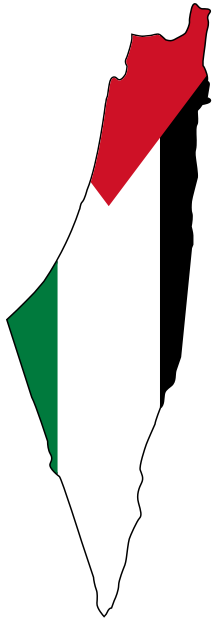
The depopulated village of Muhammadiyin / al-Azazmeh / District of Bir-a-Saba (Beer Sheva)
About the depopulated village of Muhammadiyin / al-Azazmeh
- District
- Bir-a-Saba (Beer Sheva)
Hover a dot to read the village name, or click to open its card.
Muhammadiyin / al-Azazmeh – Palestinian Bedouin Clan of the Beersheba Subdistrict
The Muhammadiyin were a major Palestinian Bedouin and semi-settled clan recorded within the al-Azazmeh tribal grouping of the Beersheba Subdistrict during the British Mandate. They did not form a single nucleated village with one permanent built-up center; their dwellings, encampments, and lands were distributed across several locations in the central and southern Beersheba region.
Their history requires a distinction between their actual tribal affiliation and their tradition of more distant origin. 'Arif al-'Arif recorded from their shaykh, 'Awda bin Jkhaydim, that the Muhammadiyin belonged socially and politically to al-Azazmeh in Palestine, while their ancestral tradition traced Hamad bin Sulayman to the Harb tribe of the Hijaz.
- District
- Beersheba
- Tribal Affiliation
- al-Azazmeh; with a tribal-origin tradition recorded by al-'Arif linking the Muhammadiyin to Harb of the Hijaz
- Type of Community
- Bedouin and semi-settled clan occupying multiple encampments and land areas rather than one nucleated village
- Distance from District Center
- No single distance; the clan was connected with several locations and directly with land around Beersheba itself
- Elevation
- No single elevation applies to all Muhammadiyin encampments
- Natural Setting
- The arid and semi-arid central and southern Naqab, including areas around Beersheba, al-Khalasa, 'Asluj, wells, seasonal fields, and grazing lands
- Population in 1931
- 1,986 – official Census of Palestine
- Population in 1944/1945
- No independently documented clan-specific figure established
- Estimated Population in 1948
- 4,041 according to Salman Abu Sitta's Register – a later estimate, not an official census
- Displacement Period
- No single 1948 date; Abu Sitta's updated Register records expulsion to Egypt during 1949–1954, with some people later returning
- Military Operation
- No independently documented Muhammadiyin-specific operation; Operation Yoav and the occupation of Beersheba form an earlier regional context
- Military Unit
- No particular brigade or battalion is independently documented at clan level
- Total Land Area
- No independent clan-specific total; Abu Sitta's 5.7 million dunums concern al-Azazmeh as a whole
- Settlements on Clan Land
- No specific post-1948 settlement can be reliably assigned to Muhammadiyin land without a clan-level cadastral map
The Muhammadiyin within al-Azazmeh
The Muhammadiyin were recorded in Mandate statistics as part of al-Azazmeh and were the largest al-Azazmeh branch in the official 1931 census.
Historical Palestinian accounts commonly divide al-Azazmeh into ten principal clans: Muhammadiyin, Subhiyin, Subayhat, Zaraba, Farahin, Mas'udiyin, 'Usiyat, Sawakhneh, Mri'at, and Sarahin.
The broader al-Azazmeh domain stretched from the Beersheba and Wadi al-Khalil area southward toward Wadi al-'Araba and Sinai, with patterns of movement governed by rainfall, wells, pasture, and seasonal cultivation.
Tradition of Muhammadiyin Origin
'Arif al-'Arif recorded a specific tradition concerning the Muhammadiyin from their shaykh, 'Awda bin Jkhaydim.
According to this account, although the Muhammadiyin were affiliated with al-Azazmeh in Palestine, their ancestor Hamad bin Sulayman belonged to the Harb tribe of the Hijaz and had lived around Sharma and 'Aynun.
This differs from the broader genealogy that al-'Arif records for al-Azazmeh as a whole.
The tradition is therefore presented as a historical tribal account rather than a conclusively documented biological or genealogical fact.
Branches of the Muhammadiyin
According to the account recorded by al-'Arif, Hamad bin Sulayman had five sons from whom numerous Muhammadiyin subdivisions descended:
- Musa'id: associated with the Jkhadma, Shayahin, and Masafir.
- Muhammad: associated with al-Malata'a / al-Maltala'a, al-Fashqan or al-Finshan in variant transcriptions, al-Shama'la, al-'Amarat, and al-Hujjaj.
- Khamis: associated with al-Hujayyat, al-Zaylan / al-Zubaylan, and al-Mashahir.
- 'Uwaymir: associated with al-'Uwaymirat and al-Mawadi.
- Musa: associated with al-'Arun and al-Bushiyya.
Later tribal lists include additional family names such as al-Sawaktah, al-Natatira, al-'Awayisha, al-Rusus, and al-Qatatwa. Because internal clan structures change and sources differ, the article uses al-'Arif's earlier classification as its historical base.
Clan Leadership
'Arif al-'Arif identifies the Muhammadiyin shaykh as:
'Awda bin Sulayman bin Salih bin Sulayman Abu Jkhaydim.
'Awda bin Jkhaydim was also one of al-'Arif's informants for the history, genealogy, and migration traditions of al-Azazmeh and the Muhammadiyin.
Dwelling Areas and Land
Later Muhammadiyin tribal documentation associates the clan with several places, including:
- al-Khalasa.
- Rumaylat Hamid.
- Ruhayba.
- Qa'at Maqbula.
- 'Asluj.
- al-Shqib.
- al-Ahwal.
- Land associated with Beersheba and its immediate surroundings.
This distribution reflects a broad tribal landscape rather than a single village center.
A single coordinate, elevation, or fixed distance from Beersheba would therefore be misleading for the Muhammadiyin as a whole.
The Muhammadiyin and the Land of Beersheba
The history of al-Azazmeh is closely connected with the establishment of modern Beersheba in the late Ottoman period.
An Institute for Palestine Studies article records that when the Ottoman government rebuilt Beersheba in 1900, it purchased approximately 2,000 dunums from al-Azazmeh and their leader Hasan al-Malt'a, demonstrating official recognition of al-Azazmeh landholding in the area.
Tribal sources associate the al-Malt'a family with the Muhammadiyin. This, however, does not establish that all land within the modern city of Beersheba belonged exclusively to the Muhammadiyin; a precise claim would require cadastral and tribal-boundary documentation.
Population in 1931
The official 1931 Census of Palestine listed the Muhammadiyin under El Azazma:
| Total | 1,986 |
|---|---|
| Category | Number |
| Males | 1,050 |
| Females | 936 |
All were recorded as Muslims.
The census table does not give an independent occupied-house figure for the Muhammadiyin, as was common in the special enumeration of Beersheba Bedouin communities.
Muhammadiyin versus the al-Azazmeh Total
Population totals for al-Azazmeh as a whole should not be presented as Muhammadiyin figures.
The Muhammadiyin numbered 1,986 in the official 1931 census, while the ten al-Azazmeh branches together had a substantially larger population.
Likewise, later estimates for the entire al-Azazmeh population in 1946 should not be used as substitutes for an independent Muhammadiyin figure.
Population in 1944/1945
The 1945 Village Statistics do not provide a clearly independent Muhammadiyin population figure comparable to those for settled villages.
No 1945 number is therefore mathematically extrapolated from the 1931 census, and the al-Azazmeh-wide 1946 estimate is not reassigned to the clan.
Estimated Population in 1948
Salman Abu Sitta's Register gives an estimated 4,041 people for Mohamediyeen / Azazema in 1948.
Several modern Palestinian databases round this figure to 4,040.
The figure of 4,041 is a retrospective demographic estimate rather than an official census conducted in 1948.
| Year | Population | Nature of Figure |
|---|---|---|
| 1931 | 1,986 | Official Census of Palestine |
| 1944/1945 | Not independently available | No reliable clan-specific figure in the 1945 Village Statistics |
| 1948 | 4,041 | Later estimate in Salman Abu Sitta's Register |
Land and Property
The 1945 Village Statistics do not provide a separate Muhammadiyin land-ownership table from which a reliable total and ownership breakdown can be constructed.
Salman Abu Sitta gives approximately 5,700,000 dunums for the al-Azazmeh tribal domain as a whole. This cannot be reassigned to the Muhammadiyin alone.
Other later databases provide substantially smaller al-Azazmeh land figures, reflecting different definitions of tribal territory and surveyed land.
No Palestinian / Transferred to Zionists / Communal-Public ownership table is therefore supplied for the Muhammadiyin without independent clan-level cadastral evidence.
Economic Life
The Muhammadiyin shared the pastoral economy of al-Azazmeh, relying on sheep, goats, camels, grazing lands, and seasonal movement between wells and pasture.
As settlement increased in some parts of the region, al-Azazmeh communities also practiced seasonal cereal cultivation and forms of semi-settled agriculture around places such as al-Khalasa and 'Asluj.
No independent agricultural table exists for the Muhammadiyin, so crop acreage or livestock totals belonging to al-Azazmeh as a whole are not reassigned to the clan.
Water, Education, and Services
Muhammadiyin movement and residence were closely connected with wells and routes extending from Beersheba toward al-Khalasa, 'Asluj, and southern areas.
The principal sources reviewed do not provide a complete independent inventory of Muhammadiyin wells.
Nor is there sufficient evidence to assign schools in Beersheba, al-Khalasa, or 'Asluj specifically to the Muhammadiyin without direct documentation.
The Muhammadiyin and the 1948 War
The military situation in the Naqab changed radically in 1948, particularly during the autumn when Israeli forces launched Operation Yoav and occupied Beersheba on 21 October.
This fundamentally affected al-Azazmeh access to land, wells, routes, and traditional grazing areas.
Salman Abu Sitta's Register, however, does not give the Muhammadiyin a specific 1948 depopulation date and does not record Operation Yoav as their clan-specific operation.
Operation Yoav should therefore remain a major regional context rather than being converted into a documented “occupation of the Muhammadiyin.”
Expulsion to Egypt, 1949–1954
Salman Abu Sitta's updated Register provides a more specific account of the Muhammadiyin's postwar fate: it records them as expelled to Egypt during 1949–1954, with some later returning.
This is important because it demonstrates that Muhammadiyin displacement was not necessarily completed during one day of the 1948 war. It formed part of a longer process continuing after the principal battles had ended.
Recent Institute for Palestine Studies research likewise documents continuing expulsions of Naqab Bedouins under military rule. A British report dated November 1949 referred to the expulsion of approximately 700 members of al-Azazmeh, although it does not identify all of them specifically as Muhammadiyin.
Occupation and Displacement Chronology
| Stage | Period | Details |
|---|---|---|
| Pre-Nakba Encampments | Until 1948 | The Muhammadiyin occupied several locations within the al-Azazmeh domain, including areas associated with al-Khalasa, 'Asluj, Ruhayba, and Beersheba. |
| Operation Yoav | 15 October – 4 November 1948 | The operation transformed military control in the Naqab, but Abu Sitta does not identify it as a Muhammadiyin-specific depopulation operation. |
| Occupation of Beersheba | 21 October 1948 | The capture of the district's administrative and commercial center radically changed Bedouin access to land and movement. |
| Continuing Expulsion and Relocation | 1949–1954 | Abu Sitta records the Muhammadiyin as expelled to Egypt during this period, with some later returning. |
| Military Rule and Spatial Concentration | 1950s | Bedouins who remained or returned to the Naqab faced movement restrictions, land confiscation, and spatial concentration. |
Military Operation and Unit
Military Operation: No single military operation is documented in Abu Sitta's Register as the specific operation that displaced the Muhammadiyin.
Operation Yoav and the occupation of Beersheba in October 1948 form an important regional context, while the clan's displacement continued into the 1949–1954 period.
Military Unit: No particular brigade or battalion is independently documented at the Muhammadiyin clan level.
Cause of Displacement
The loss of Muhammadiyin access to their encampments and lands formed part of the military transformation of Beersheba and the Naqab during the Nakba and the subsequent expulsion and relocation policies affecting Bedouin communities.
Because the updated Register gives no single 1948 depopulation date and explicitly records expulsion to Egypt between 1949 and 1954, the most accurate description is a multi-stage process of displacement and expulsion that began with the military conquest of the Naqab and continued during the postwar years.
Destruction of Dwellings
There was no single compact masonry village called Muhammadiyin for which a reliable destruction percentage can be calculated.
The clan occupied multiple encampments and areas, and the available sources do not provide a comprehensive survey of structures destroyed or surviving at al-Khalasa, Ruhayba, 'Asluj, al-Shqib, and other locations.
No unsupported statement such as “completely destroyed” or numerical destruction percentage is therefore used.
Settlements on Muhammadiyin Land
Numerous Israeli settlements and installations exist today within the broader historical al-Azazmeh domain, but the reviewed sources do not provide a separate clan-level cadastral map defining Muhammadiyin land against the lands of other al-Azazmeh branches.
No particular post-1948 settlement is therefore assigned specifically to the Muhammadiyin without direct land-boundary documentation.
The documented Ottoman purchase of 2,000 dunums from al-Azazmeh for the establishment of modern Beersheba is a separate pre-1948 historical matter and should not be confused with a post-1948 settlement.
Muhammadiyin / al-Azazmeh Today
The Muhammadiyin did not disappear as a tribal community after the Nakba. Abu Sitta's updated Register indicates that members were expelled to Egypt between 1949 and 1954 and that some later returned, while subsequent migration dispersed other families outside the Naqab.
Modern tribal sources preserve Muhammadiyin family and branch identities in Jordan and elsewhere, while al-Azazmeh communities also continue to exist within the Naqab. The principal sources used here, however, do not provide one contemporary official census covering all Muhammadiyin descendants.
There is consequently no single former “Muhammadiyin village site” to describe today. Reconstructing the present condition of their historical lands requires matching old tribal boundaries and place-names with cadastral and field documentation.
This section therefore summarizes the documented historical trajectory and is not a comprehensive 2026 field or demographic survey of the Muhammadiyin.
Sources
- Government of Palestine – Census of Palestine, 1931: Muhammadiyin / El Azazma
- 'Arif al-'Arif – Tarikh Bir al-Saba' wa-Qaba'iliha
- Institute for Palestine Studies – Mansour Nasasra, Bir Al-Saba' District and Southern Palestine
- Salman Abu Sitta – Register of Depopulated Palestinian Localities: Mohamediyeen / Azazema
- Palestine Land Society – The Palestinian Nakba: Mohamediyeen / Azazema
- PalQuest – Operation Yoav, for the wider military context
- Encyclopedia of Palestinian Villages – Muhammadiyin / al-Azazmeh
- Local Tribal Documentation – Muhammadiyin Branches and Historical Land Areas
Photos from the village's people
Photos sent in by visitors and published after review.
Add a photo of this village
Log in to add photos of this village.
Other villages from Bir-a-Saba (Beer Sheva)
More from the archive
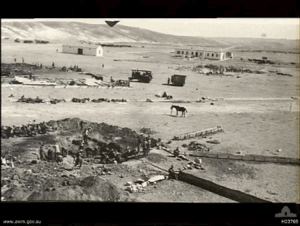 Bir-a-Saba (Beer Sheva)
The depopulated village of Asluj / District of Bir-a-Saba (Beer Sheva)
Bir-a-Saba (Beer Sheva)The depopulated village of Dhulam Abu Juwayid / Tayaha / District of Bir-a-Saba (Beer Sheva)
Bir-a-Saba (Beer Sheva)The depopulated village of Sawakhneh / al-Azazmeh / District of Bir-a-Saba (Beer Sheva)
 Download Our Palestine App
The whole archive in the palm of your hand: depopulated villages, the Nakba, the massacres and Al-Aqsa — free, with no ads to erase the story.
Download Our Palestine App
The whole archive in the palm of your hand: depopulated villages, the Nakba, the massacres and Al-Aqsa — free, with no ads to erase the story.
Comments
No comments yet — be the first to write one.
Add your comment
Name and email are optional. Comments appear after review.