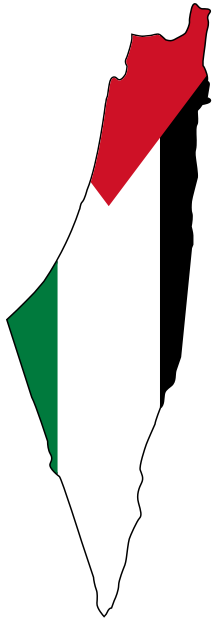
Did Palestinians Sell Their Land? The Truth in Numbers and Documents
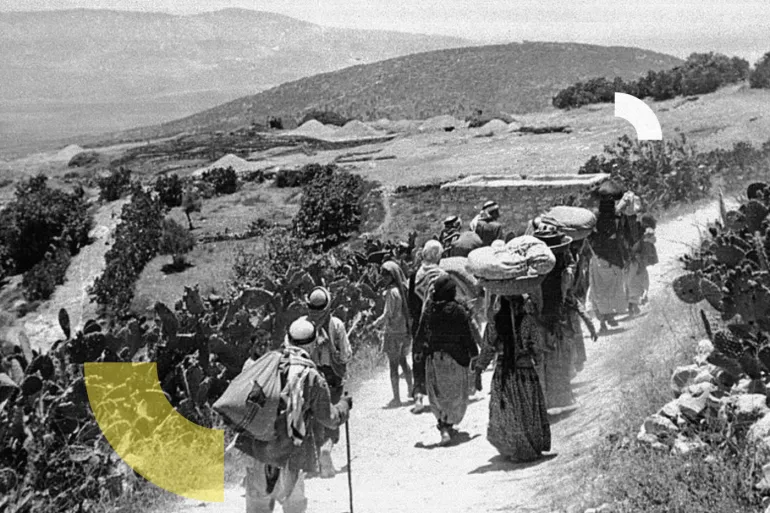
Did Palestinians Sell Their Land? The Truth in Numbers and Documents
For decades, one sentence has been repeated so often that it sounds simple: "The Palestinians sold their land, so why are they demanding it back today?" What began as a historical claim that needed proof has become a political shorthand for a long story, one that runs from Ottoman land laws, through Zionist settlement, the British Mandate and the revolts of the Palestinian people, to the occupation of Palestine in 1948, the Nakba, and the expulsion of hundreds of thousands of Palestinians from their towns and villages.
The basic problem with this sentence is that it confuses three completely different things: the purchase of specific plots of land through legal contracts, the ownership of the land of Palestine as a whole, and the military seizure that took place in 1948. The existence of real land sales does not mean that Palestine was sold, just as an investor buying thousands of hectares in a country does not mean that he has bought that country or acquired sovereignty over it.
To understand what actually happened, we need to go back to the numbers, the laws and the nature of land ownership; to find out who was selling and who was buying; and then to compare the area that Jewish institutions and individuals legally owned with the area seized by Zionist militias and then by the Zionist occupation in 1948. Finally, we need to trace what happened to the land after the Nakba.
What is wrong with saying "the Palestinians sold their land"?
The right question is not "Did any Palestinian ever sell land to a Jew or to a Zionist institution?" The answer to that question is yes: there were documented sales by Palestinian owners. But by far the larger share came from non-Palestinian Arab landlords who lived in Beirut, Damascus and elsewhere, from state land granted by the Mandate authorities, and from churches and foreign companies.
The more important historical question is this: were these sales the way in which Palestine passed from an Arab Palestinian people, who made up the majority of the population and owned most of the land, to the State of Israel, which was established in 1948 on most of the land of Palestine?
The historical figures do not support this explanation. Even on the eve of partition, Jewish ownership did not exceed a limited share of the total area of Palestine.
The essential difference is between "buying land in Palestine" and "owning Palestine." The first did happen, on a limited scale. The second is not supported by the ownership records from before 1948.
Land ownership under the Ottomans and the musha' system
To understand the issue, we first have to set aside a modern assumption: that every plot of land in the nineteenth century was registered in the name of a person holding a title deed like the ones we know today.
The Ottoman system was far more complex. It divided land into different legal categories, including mulk (private property), miri (state-owned land held by cultivators), waqf (religious endowment), matruka (land reserved for public use) and mawat ("dead" or uncultivated land). Rights of use, cultivation and inheritance did not always match the modern concept of private property.
The musha' system of communal land was dominant in the Palestinian countryside. Some studies estimate that it covered about 70% of agricultural land until the beginning of the Mandate. Under this system, village land was periodically redistributed by lot among the village's families, so that shares rotated from one household to another without sales, purchases or individual deeds. A peasant's holding was protected by custom and by the testimony of his fellow villagers, as long as he farmed the land and paid its taxes.
So the absence of an individual deed in a particular peasant's name does not mean that the land was "empty," unused, or free of existing rights.
The Ottoman Land Code of 1858 and the tabu registry: an administrative reform that became a serious problem
The Ottomans issued the Land Code in 1858, followed by the tabu land registration system in 1859, as part of a wider project to reorganize administration and taxation. Together they required land to be registered in the name of the person using it. The law had nothing to do with Zionism, which had not yet emerged as an organized political movement.
But its implementation had serious consequences. Peasants widely avoided registration for three main reasons: fear of military conscription, because tabu records revealed to the state how many men lived in each village; inability to pay registration fees and the taxes that followed; and a lack of trust in the state and its procedures.
As a result, large areas were registered in the names of notables, merchants, moneylenders and wealthy urban families, some of them from outside Palestine, while peasants went on farming the land generation after generation. Many small owners also lost their land to moneylenders after falling into debt, and stayed on it as hired laborers.
This created a dangerous gap between the name in the land registry and the people who actually lived on the land and depended on it for their livelihood. It was this gap that Zionist institutions would later exploit.
When could foreigners own land in the Ottoman Empire?
It is often said that foreigners were allowed to own property in 1869. More precisely, the Ottoman law granting foreigners the right to hold real estate was issued in 1867, with foreign owners subject to Ottoman laws and taxes on property.
Even before that, the first attempts at Jewish land ownership came with British intervention. Moses Montefiore, a wealthy British Jew who first visited Palestine in 1827, obtained Ottoman permission, with his government's backing, to buy land outside the walls of Jerusalem. He later built on it the first Jewish neighborhood outside the Old City.
With the rise of the organized Zionist movement in the late nineteenth century, acquiring land became central to its project. The Ottoman authorities were aware of this. In 1881 and again in 1892, they imposed restrictions on land ownership by foreign Jews and on their immigration to the district of Jerusalem, although these restrictions were enforced unevenly and were often circumvented through bribery, European consuls and intermediaries.
Despite all this, by the end of Ottoman rule Jewish ownership amounted to only about 1% to 2% of the area of Palestine, according to various estimates.
Did sales really happen? And who sold?
It would be historically wrong to say that no land was ever sold. There are documented contracts and transactions that began in the late nineteenth century and continued throughout the British Mandate. They were handled by specialized Zionist institutions, most prominently the Jewish National Fund (Keren Kayemet), the Foundation Fund (Keren Hayesod) and the Palestine Land Development Company.
The real question is: where did this land come from? Studies based on records from that period indicate that land bought directly from Palestinian peasants, often under the pressure of debt and moneylenders, made up only about 9.4% of all the land that Jews came to own. The remaining share, about 90.6%, came from:
- Large landlords and absentee owners, most of them Lebanese and Syrian families living outside Palestine.
- State land granted or leased to Zionist institutions by the British Mandate government.
- Land owned by churches and foreign companies.
- A number of Palestinian landowners and notables, whose share grew in the 1930s and who faced fierce condemnation and boycotts from their own society.
So the question is not whether sales took place, but how large they were relative to Palestine as a whole, who made them, and what they had to do with what happened in 1948.
The non-Palestinian families who sold land
After the tabu law and the law on foreign ownership, wealthy families from Beirut and Damascus were able to buy vast areas of Palestinian land at state auctions or from indebted peasants, without ever living on it. Some studies estimate that Lebanese families owned about half a million dunams, and Syrian families about 57,000 dunams. (One dunam is 1,000 square meters, roughly a quarter of an acre.)
Below are some of the most prominent non-Palestinian families and individuals who sold land to Zionist institutions, as compiled by Midan, part of Al Jazeera Net:
| Other nationalities | |||
|---|---|---|---|
| Syrian | |||
| Lebanese | |||
| Family or individual | Nationality | Area (dunams) | Location of sale |
| Heirs of Salim Ramadan | Lebanese | 3,000 | Tiberias sub-district, Hittin |
| Heirs of Jamal and Malki | Lebanese | 2,500 | Tamrin |
| Emir Shihab | Lebanese | 1,100 | al-Khalisa |
| Shihab | Lebanese | 1,300 | al-Na'ima |
| Father Shukrallah | Lebanese | 900 | Qaddita |
| Father Shukrallah | Lebanese | 700 | Yarda |
| Sursock family | Lebanese | 240,000 | Nazareth sub-district, Marj Ibn Amer |
| Najib Sursock | Lebanese | 26,500 | Tell al-Daru and Jalud |
| Ahmad al-As'ad | Lebanese | 2,000 | al-Manara and al-Udaysa |
| Za'arab | Lebanese | 5,000 | al-Hanuta |
| Tayyan family | Lebanese | 21,500 | Tulkarm sub-district, Wadi al-Hawarith |
| Salam family | Lebanese | 41,500 | Huleh concession area |
| Francis | Lebanese | 3,000 | Safad sub-district, Dafna |
| al-Uwayni | Lebanese | 2,500 | Acre sub-district, Tahadiya |
| Farha | Lebanese | 1,400 | al-Zawiya |
| al-Dabbaki and Shams | Lebanese | 1,600 | al-Dawwara |
| Villagers of Dishum | Lebanese | 1,200 | Jabal Mimas |
| Villagers of Qutayt | Lebanese | 1,100 | Khawara |
| Villagers of Shebaa | Lebanese | 4,500 | Samakh |
| Ghulayma and Jabbara | Lebanese | 1,500 | Khan al-Duwayr |
| al-Zurra | Lebanese | 4,000 | al-Zuq al-Tahtani |
| Farhat and al-Bizza | Lebanese | 2,500 | al-Malikiyya |
| al-Mardini | Lebanese and Syrian | 9,000 | Qadas |
| Total | 378,300 | ||
| Heirs of Emir Abdelkader al-Jazairi | Syrian | 34,000 | Kafr Sabt and al-Shajara |
| Heirs of Emir Abdelkader al-Jazairi | Syrian | 2,000 | Qirad al-Khayt, al-Bakkara and al-Shanama |
| al-Qabbani family | Syrian | 10,550 | Wadi al-Qabbani |
| Emirs Fa'ur and Shaman | Syrian | 800 | al-Salihiyya |
| al-Fadl family | Syrian | 6,200 | al-Burjiyyat |
| Za'al Sallum | Syrian | 6,500 | Khirbat al-Samman |
| Busu | Syrian | 4,000 | Khiyam al-Walid |
| al-Makkawi family | Syrian | 6,600 | al-Khafas |
| Total | 70,650 | ||
| Count Chedid | Egyptian | 8,000 | Samakh |
| A Persian Baha'i | Iranian | 8,000 | Negev |
| Total | 16,000 | ||
| Grand total | 464,950 | ||
Source: Midan – Al Jazeera Net. Totals recalculated from the row figures.
This table alone accounts for about 465,000 dunams sold by families and individuals from outside Palestine, between a quarter and a third of all the land Jews owned by 1948.
The Sursock family and Marj Ibn Amer: the clearest example
The Sursock family of Beirut played the largest role in the transfer of land. It owned large parts of Marj Ibn Amer (the Jezreel Valley), the most fertile plain in Palestine, and sold them to Zionist institutions during the first decades of the twentieth century, especially in the 1920s. The Palestinian historian Emile Ghouri estimated that the family sold about 400,000 dunams in Palestine in total.
The legal owner lived in Beirut, while the peasants lived on the land and had farmed it for generations. Zionist institutions required sellers to hand over the land empty of its inhabitants. According to studies of these transactions, the sale of about a quarter of a million dunams in the valley led to the displacement of the inhabitants of 20 to 25 villages, some 2,546 families, or about 15,000 people.
The British Shaw Commission, which investigated the Buraq Revolt of 1929, reported large-scale land sales between 1921 and 1929, followed by the removal of numbers of Arabs from land they had occupied, some of whom received meager financial compensation.
This picture alone shows why the phrase "the Arabs sold the land" falls short. The person who signed the sale contract was not the peasant who lived on the land. More often, it was an absentee owner who had only ever seen it in the registry.
The peasant between legal ownership and the right of use
We must distinguish between the "registered owner" and the "resident farmer." In Palestinian society before 1948, a large part of the population depended on farming and herding, and in areas of large estates the relationship to the land was based on tenancy or traditional rights of use, not on modern individual ownership.
Under Arab landlords, a peasant usually stayed on the land as a farmer or tenant even when it changed hands. But when it passed to Zionist institutions, he was evicted, because these institutions followed a policy of "Hebrew labor" that refused to employ Arabs in the settlements. Menachem Ussishkin, one of the leading theorists of settlement, expressed this approach early on, linking the success of the Zionist project to buying land and then settling Jews on it in place of Arab workers.
This was not simply a Palestinian claim. The British Mandate's own commissions discussed it, legislation was passed to protect tenant farmers, and Britain later restricted land transfers amid growing concern about the emergence of a class of landless Arab peasants.
The British Mandate: from the Balfour Declaration to land transfer laws
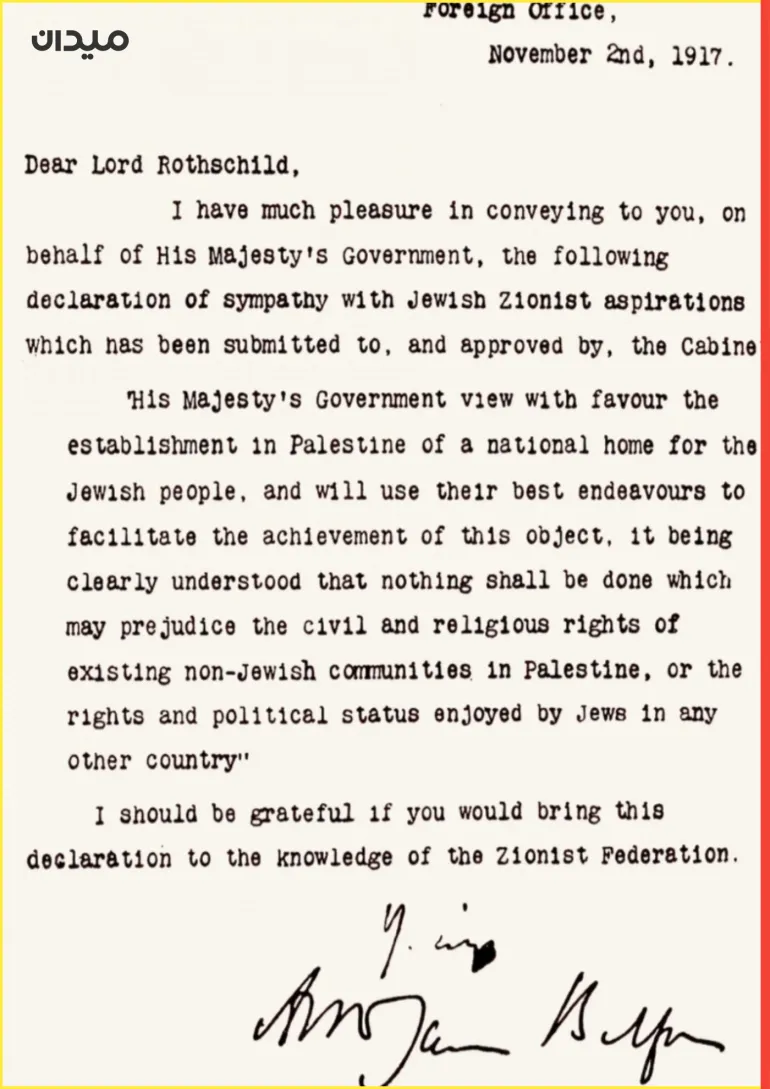
On 2 November 1917, British Foreign Secretary Arthur James Balfour sent a letter to Lord Rothschild declaring his government's support for "the establishment in Palestine of a national home for the Jewish people," on the understanding that nothing would be done to prejudice "the civil and religious rights of existing non-Jewish communities in Palestine," communities that made up more than 90% of the population. This commitment was later written into the Mandate for Palestine.
Laws designed to transfer land
Britain's role went beyond a political promise. Herbert Samuel, the first British High Commissioner for Palestine and a Jewish politician sympathetic to Zionism, issued within less than a year a series of laws that removed Ottoman restrictions on Jewish ownership. The most significant laws of the Mandate period include:
- Land Transfer Ordinance (1920): allowed land to be mortgaged to banks and transferred to companies, and was followed by official recognition of the Jewish National Fund as a public-benefit institution entitled to buy land.
- Mahlul Land Ordinance (1920): returned to the state any land whose heirs had died out or that had gone uncultivated for three years, even if someone was in possession of it.
- Mawat Land Ordinance (1921): stripped anyone who cultivated "dead" land without the administration's permission of any right to it.
- Expropriation of Land Ordinance (1926): gave the government the right to expropriate land in the name of "public benefit."
- Land Settlement Ordinance (1928): under which title settlement began in the coastal and northern plains, the very areas where Jewish purchases were concentrated.
- Land (Acquisition for Public Purposes) Ordinance (1943): expanded the High Commissioner's powers to acquire any land.
As a result of these laws, musha' land, the biggest obstacle to Zionist ownership, fell from about 70% in 1918 to about 40% in 1940.
Concessions on state land
The Mandate government also granted concessions to use state land in a grossly unequal way. By 1943, long-term concessions granted to Jews exceeded 175,000 dunams, compared with only about 1,222 dunams for Arabs, who received most of their share through short concessions of no more than three years. Among the best known were the Dead Sea concession and the Palestine Electric Corporation concession.
| Duration and recipient of concession | Area in dunams, 1937 | Area in dunams, 1943 |
|---|---|---|
| Long-term concessions to Jews | 95,000 | 175,088 |
| Three-year concessions to Jews | – | 2,422 |
| Total concessions to Jews | 95,000 | 177,510 |
| Long-term concessions to Arabs | – | 1,222 |
| Three-year concessions to Arabs | 25,000 | 26,522 |
| Total concessions to Arabs | 25,000 | 27,744 |
Source: Midan – Al Jazeera Net. Totals recalculated from the row figures.
A late shift in British policy
British policy changed partially under the pressure of the Palestinian revolts. In February 1940, Britain issued the Land Transfers Regulations, which divided Palestine into three zones and banned or severely restricted the transfer of land from Arabs to Jews in most of the country, with the declared aim of protecting small Arab farmers. But the shift came only after Zionist institutions had already entrenched themselves in the fertile plains.
Palestinian resistance to the transfer of land
Palestinians were not bystanders to the transfer of their land. From the late Ottoman period, a Palestinian press emerged that warned against settlement. Among its most prominent papers were al-Karmil, founded by Najib Nassar in Haifa in 1908, and Filastin, founded by Issa al-Issa and Yousef al-Issa in Jaffa in 1911. In 1911, Najib Nassar also wrote one of the first Arabic books on Zionism and its aims.
On the ground, the peasants of al-Fula in Marj Ibn Amer resisted the transfer of their land after it was sold by the Sursock family around 1910 and 1911. The district governor of Nazareth at the time, Shukri al-Asali, refused to facilitate its handover, and the affair caused widespread controversy in the Arab press and the Ottoman parliament.
During the Mandate, campaigns emerged to boycott and expose land brokers. In January 1935, a conference of Palestinian religious scholars in Jerusalem issued a fatwa forbidding the sale of land to Zionists or acting as a broker in such sales, and declaring it a betrayal of religion and homeland. Immigration and land became the core issues of the Palestinian national movement, and they erupted in successive revolts, most notably the Buraq Revolt of 1929 and the Great Revolt of 1936.
The Buraq Revolt of 1929
In August 1929, the Buraq Revolt broke out after tensions escalated over the Buraq Wall, the western wall of al-Aqsa Mosque, following attempts by Zionist groups to change the status quo there and a provocative march they organized to the wall on 15 August. Clashes soon spread from Jerusalem to Hebron, Safad, Jaffa and elsewhere. Hundreds of Arabs and Jews were killed or wounded, and many of the Arab dead were shot by British forces.

The Mandate authorities responded with a campaign of arrests and trials. On 17 June 1930, they executed three revolutionaries in Acre prison: Fuad Hijazi, Mohammad Jamjoum and Ata al-Zeer, on a day Palestinians came to remember as "Red Tuesday."
Most importantly for the land question, the revolt forced Britain to investigate its causes. The Shaw Commission concluded that land transfers, the eviction of peasants and Jewish immigration were among the fundamental causes of Arab anger. The Hope Simpson Report of 1930 then confirmed how serious the problem of landless peasants had become, and the Passfield White Paper proposed restricting immigration and land transfers. But Zionist pressure forced the British government to effectively reverse it through Prime Minister Ramsay MacDonald's letter of 1931, which Palestinians called the "Black Letter."
The Great Palestinian Revolt of 1936–1939
In November 1935, Sheikh Izz al-Din al-Qassam was killed with several of his comrades in the Ya'bad woods near Jenin after a clash with British forces, and his martyrdom became the spark that set the country alight. In April 1936, the Great Palestinian Revolt began with a general strike that lasted about six months, one of the longest in modern history, and the Arab Higher Committee was formed to lead the national movement.

The revolt demanded an end to Jewish immigration, a ban on the transfer of land to Jews, and the establishment of a national government representing the majority of the population. After the Peel Commission proposed partitioning Palestine for the first time in 1937, the revolt entered its second, armed phase, and the rebels took control of large parts of the countryside and some towns.

Britain crushed the revolt with extreme brutality: thousands killed, tens of thousands detained, homes blown up, executions and collective punishment of villages, alongside the arming and training of Zionist militias. The revolt ended in 1939, having exhausted Palestinian society and weakened its leadership and military capacity less than ten years before the Nakba.
Its political results included the White Paper of 1939, which restricted immigration, followed by the Land Transfers Regulations of 1940. This alone answers the claim of "selling": British restrictions on land transfers were not a gift. They were won with the blood of the revolutionaries.
A people who held a six-month general strike and fought a three-year armed revolt, one of whose main demands was to stop the transfer of land, cannot be described as having collectively decided to sell their country.
The decisive figures: how much did Jews own before 1948?
Here the discussion becomes clearer, because we have official data from the British Mandate. According to Village Statistics 1945, later used by the United Nations, the total area of Palestine was about 26.3 million dunams, distributed roughly as follows:
| Type of ownership | Approximate area | Approximate share |
|---|---|---|
| Arab and other non-Jewish ownership | 12,574,774 dunams | about 47.8% |
| Jewish ownership | 1,491,699 dunams | about 5.7% |
| Public land | 12,254,032 dunams | about 46.5% |
| Total | 26,320,505 dunams | 100% |
Purchases continued after 1945, so figures for 1947 range between 6% and 7% depending on the year used and the method of calculation. But the difference does not change the overall picture: after more than six decades of buying, with the full support of the British colonial power, Jewish ownership did not exceed about 6% to 7% of the land of Palestine.
Where was Jewish ownership concentrated?
It was concentrated in the coastal plain and the north, in the sub-districts of Jaffa, Haifa, Tiberias, Beisan, Safad and Nazareth, the areas where absentee landlords sold their land and where British title settlement began. In the Palestinian highlands, Jewish ownership was almost non-existent: practically zero in the Ramallah sub-district, and less than 1% in Nablus, Jenin and Hebron.
| Sub-district | Share of Jewish ownership |
|---|---|
| Ramallah | – |
| Nablus | 0.09% |
| Jenin | 0.5% |
| Hebron | 0.6% |
| Beersheba | 1.3% |
| Acre | 2.2% |
| Jerusalem | 3.4% |
| Gaza | 5.2% |
| Ramle | 13.8% |
| Tulkarm | 18% |
| Nazareth | 24.9% |
| Safad | 27.7% |
| Beisan | 36.8% |
| Jaffa | 42.2% |
| Haifa | 42.5% |
| Tiberias | 44% |
Source: Midan – Al Jazeera Net.
What about "public land"?
Some argue that nearly half the country was public land and therefore did not belong to Palestinians. This conclusion requires great caution. A large part of this category lay in the Beersheba sub-district (the Naqab, or Negev), where Bedouin tribes used, inherited and farmed the land under customary systems that were never entered in the modern land registry. And miri land was not empty land that the state could dispose of at will; it usually carried long-standing rights of cultivation, use and inheritance.
Public land in an administrative classification is not land without people, and in any case it was not Jewish-owned before 1948.
Even the Jewish Agency itself, in the material it submitted to the United Nations Special Committee on Palestine in 1947, spoke of Jewish ownership amounting to only a limited share of the country's area.
This matters because it does not rely on an Arab or Palestinian account. It appears in Mandate records, in UN documents and in the figures of the Zionist institutions themselves.
The partition resolution: from about 6% ownership to a state on about 56% of Palestine
On 29 November 1947, the UN General Assembly adopted Resolution 181, which proposed dividing Palestine into an Arab state and a Jewish state, with a special international regime for Jerusalem. The plan allocated to the proposed Jewish state about 15.26 million dunams, nearly 56.5% of the area of Palestine, at a time when Jews made up about a third of the population and owned about 6% to 7% of the land.
According to some studies, Jewish ownership even within the borders of the proposed Jewish state did not exceed about 1.38 million dunams, compared with about 3.58 million dunams of private Arab ownership within the same borders. The rest of the area was state land or land used by Arabs under customary rights.
Here we must again distinguish between two concepts:
- Land ownership: who legally owns a given plot of land?
- Sovereignty: to which state will the area belong politically?
The partition resolution was not a sale contract transferring ownership of private land to Jews. It was a plan to divide sovereignty, one that gave a recently arrived minority more than half the country. The Palestinian leadership and the Arab states rejected it, while the leadership of the Jewish Agency accepted it as a basis for establishing a state.
1948: The occupation of Palestine and the Nakba
This is the point that is usually lost when the story is reduced to "selling land."
After the partition resolution, Zionist militias, the Haganah, the Irgun and the Stern Gang, began attacking Palestinian towns and villages. In March 1948, "Plan Dalet" was drawn up to seize as much of Palestine as possible. On 14 May 1948, as Britain withdrew, the Zionist leadership declared the establishment of Israel, and Arab armies entered the following day. By the armistice agreements of 1949, the Zionist occupation had seized about 78% of historic Palestine.

This occupation was not the result of buying land from its owners, but of military force and mass expulsion. The United Nations states that about 750,000 Palestinians became refugees during the Nakba, more than half of the Palestinian people at the time.
Nor was this expulsion a spontaneous flight from combat zones. It included direct expulsions, as in Lydda and Ramle in July 1948, and massacres, the most notorious being the Deir Yassin massacre of 9 April 1948, which spread terror through the surrounding villages. Much of the expulsion took place before 15 May, before the Arab armies entered.

These events are no longer told only by Palestinian memory. They have been documented by Israeli historians who studied military and state archives, among them Benny Morris and Ilan Pappé, although they differ in how they explain the motives and how far the expulsions were planned in advance. David Ben-Gurion himself, who became Israel's first prime minister, told a meeting of the Jewish Agency Executive in 1938: "I support compulsory transfer. I don't see anything immoral in it."
After the Nakba, the refugees were barred from returning, and hundreds of depopulated Palestinian villages were destroyed or emptied of their inhabitants. The late historian Walid Khalidi documented 418 villages in his book All That Remains, while Salman Abu Sitta's figures are higher.
Here the basic arithmetic flaw in the claim that "Palestine was sold" becomes clear. If Jewish ownership just before the Nakba stood at around 6% of the country, while the new state was established on about 78% of it, then the difference, more than 70% of the land of Palestine, was not bought. It was occupied.
What happened to refugee land after the Nakba?
After the establishment of Israel, the Zionist occupation built a legal system for seizing the property of displaced Palestinians. The most important of these laws was the Absentees' Property Law of 1950, which placed vast amounts of Palestinian land, homes and real estate, and even Islamic waqf property, under the control of the "Custodian of Absentee Property." Large parts of it were then transferred to the "Development Authority," the state and the Jewish National Fund.
This is a fundamental legal distinction: land transferred under absentee laws after its owner was expelled cannot be described as land the refugee sold before his expulsion. Its ownership was transferred by a law issued by the very party that expelled him and barred him from returning.
"Present absentees": land confiscated from owners who never left
Perhaps the clearest proof that this was never a matter of sales is the fate of the Palestinians who never left the country at all.
The Absentees' Property Law defined an "absentee" very broadly, to include anyone who left their usual place of residence after 29 November 1947 for an area outside the control of the occupation, even if it was a neighboring village where they sheltered for a few days during the fighting. As a result, tens of thousands of Palestinians found themselves citizens of Israel, living just a few kilometers from their original villages, yet legally classified as "absentees" and deprived of their land and homes. They became known as "present absentees," and the case of the villages of Iqrit and Kafr Bir'im remains a testament to their plight.
Then came the Land Acquisition Law of 1953, which retroactively legalized the confiscation of large areas of Arab land, including land owned by citizens who were still living there.
Confiscations continued in the following decades until, on 30 March 1976, they erupted into a general strike and widespread confrontations against the confiscation of land in the Galilee, in Sakhnin, Arraba, Deir Hanna and other towns, in which six Palestinians were killed. Since that day, Palestinians everywhere have commemorated "Land Day."
These people did not sell their land and did not leave their homeland, yet they lost it. This alone shows that the transfer of land was not a real estate deal but a policy of seizure.
The right of return and Resolution 194
The importance of this issue is not only historical. It has a basis in international law that still stands today.
On 11 December 1948, the UN General Assembly adopted Resolution 194, whose paragraph 11 resolved that refugees wishing to return to their homes and live at peace with their neighbors should be permitted to do so at the earliest practicable date, and that compensation should be paid for the property of those choosing not to return and for loss of or damage to property. The General Assembly has reaffirmed this resolution many times since.
The same resolution established the United Nations Conciliation Commission for Palestine, which during the 1950s and 1960s compiled detailed records of individual refugee property based on Mandate records. These records are further evidence that this property was registered in the names of its Palestinian owners, not that it had been sold.
This makes clear that the phrase "they sold their land" does not merely misread history. In practice, it is used to delegitimize a right recognized under international law.
What about the common objections?
"Palestinian notables, some of them national leaders, sold land or acted as brokers"
This is partly true, and it was documented by the American researcher Kenneth Stein in his book The Land Question in Palestine, 1917–1939. Honest historical writing has no need to deny it. These sales had real local effects, and those who made them, along with the brokers, faced fierce condemnation and boycotts within Palestinian society; the rebels even targeted them during the 1936 revolt.
But these facts do not change the basic arithmetic: all the sales combined, by all sellers, Palestinian and non-Palestinian, did not exceed about 6% to 7% of the country's area. Even if hundreds or thousands of landowners sold, that does not prove that the 750,000 refugees who lost their homes in 1948 had sold them.
"The Arabs rejected partition and their armies went to war, so they bear the consequences"
Whatever one thinks of the rejection of partition, it does not turn expulsion into a sale or confiscation into a contract. International law does not permit civilians to be stripped of their property and barred from returning to it, which is precisely what Resolution 194 affirmed. Moreover, much of the expulsion, including the expulsions from Haifa and Jaffa and the Deir Yassin massacre, took place before 15 May 1948, before the Arab armies entered.
"Most of the land belonged to the government, not to Palestinians"
This point was discussed in the section on the figures: public land in an administrative classification was not empty of people or of rights of use, and much of it was Bedouin grazing and farming land in the Naqab. In any case, this land was not Jewish property bought before the Nakba.
Why has the claim "the Palestinians sold their land" persisted?
Because it turns an extremely complex history into an easy story told in a single sentence. The question of Palestine involved British colonialism, the Zionist project, immigration, land transfer laws, revolts, occupation, expulsion and international politics. The phrase "they sold their land" erases all of these stages, turns occupation and expulsion into a real estate transaction, and confuses the conduct of individuals, many of whom were not even Palestinian, with the position of an entire people.
More dangerously, it serves a political purpose: if the land was sold, the refugees have no right to it. That is why refuting it is not a historical luxury, but part of defending a right that still stands.
Conclusion: did the Palestinians sell Palestine?
Yes, land was sold to Zionist institutions before 1948. But the largest share came from non-Palestinian absentee owners, such as the Sursock, Salam and Tayyan families of Lebanon and the Qabbani family and the heirs of Emir Abdelkader al-Jazairi in Syria, and from state land granted by the British Mandate authorities.
British Mandate and UN records show that just before the Nakba, Jews owned only about 6% to 7% of the land of Palestine, despite more than six decades of purchases and British support.
The decisive shift came in 1948, when Zionist militias and then the Zionist occupation seized about 78% of the land of Palestine, expelled some 750,000 Palestinians, and destroyed hundreds of villages. The property of the refugees, and even of Palestinians who remained in the country, was then transferred through absentee and acquisition laws, not through sale contracts.
Palestinians, for their part, resisted the transfer of their land through the press, fatwas and boycotts, and then through the Buraq Revolt and the Great Revolt, in which thousands of them were killed.
The most accurate historical formulation is neither that "no one sold any land" nor that "the Palestinians sold Palestine." It is that limited sales did take place, most of them by absentee owners, in the midst of an escalating struggle over land that Palestinians resisted; but those sales do not explain the occupation of most of Palestine in 1948, nor do they cancel the right of the expelled owners of the land to return to it.
Sources and references
Official documents
- United Nations – Ad Hoc Committee on the Palestinian Question: Land Ownership Statistics, 1945
- United Nations – The Origins and Evolution of the Palestine Problem
- United Nations – Testimony of Representatives of the Jewish Agency before UNSCOP, 1947
- United Nations – Acquisition of Land in Palestine
- UN General Assembly – Resolution 194 (11 December 1948)
- UNRWA – Palestine Refugees
- Ottoman Law Granting Foreigners the Right to Hold Real Estate, 1867 – U.S. Office of the Historian
- PalQuest – The Legal Organization of Land in Palestine (Arabic)
- PalQuest – Shaw Commission Report, 1930
- PalQuest – Passfield White Paper
Articles
Books and studies
- Akram Hijazi, The Social Roots of the Nakba: Palestine 1858–1948 (Arabic).
- Sami Hadawi, Village Statistics, 1945: A Classification of Land and Area Ownership in Palestine, PLO Research Center, 1970.
- Sami Hadawi, Memorandum on Arab Immovable Property in Palestine Falling Within the Area Occupied by the Jews, United Nations Conciliation Commission for Palestine.
- Sami Hadawi, Palestinian Rights and Losses in 1948: A Comprehensive Study, Saqi Books, 1988.
- Walid Khalidi (ed.), All That Remains: The Palestinian Villages Occupied and Depopulated by Israel in 1948, Institute for Palestine Studies, 1992.
- Rashid Khalidi, The Hundred Years' War on Palestine: A History of Settler Colonialism and Resistance, 1917–2017, 2020.
- Salman Abu Sitta, Atlas of Palestine 1917–1966 (Part I, free PDF), Palestine Land Society, 2010.
- Emile Ghouri, Palestine Across Sixty Years, Beirut (Arabic).
- Kenneth W. Stein, The Land Question in Palestine, 1917–1939, University of North Carolina Press, 1984.
- Benny Morris, The Birth of the Palestinian Refugee Problem Revisited, Cambridge University Press, 2004.
- Ilan Pappé, The Ethnic Cleansing of Palestine, Oneworld, 2006.
Sources of tables and images
- Tables of land sellers, concessions and ownership by sub-district: Midan – Al Jazeera Net, with totals recalculated.
- Balfour Declaration image: the original text of the letter, 1917.
- Images of the Buraq Revolt and the Great Revolt: Matson Collection, Library of Congress, and Wikimedia Commons (public domain).
- Images of the Nakba: Wikimedia Commons.
Read also
The videos that inspired this article
- Ta'a Ishrab Shai – Did the Palestinians Sell Their Land? (Arabic)
- Second video on the claim that Palestinians sold their land (Arabic)
- Third video on Palestinian land ownership and its transfer (Arabic)
Methodological note: The three videos served as a starting point for this article, but the figures and dates in it were checked against historical documents and independent sources, so some details may differ from the wording used in the videos.
More from the archive


 Download Our Palestine App
The whole archive in the palm of your hand: depopulated villages, the Nakba, the massacres and Al-Aqsa — free, with no ads to erase the story.
Download Our Palestine App
The whole archive in the palm of your hand: depopulated villages, the Nakba, the massacres and Al-Aqsa — free, with no ads to erase the story.
Comments
No comments yet — be the first to write one.
Add your comment
Name and email are optional. Comments appear after review.