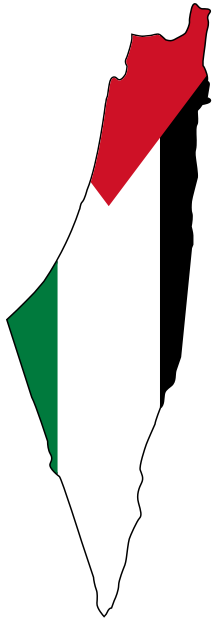
The Peel Commission Recommends the Partition of Palestine and the Transfer of Palestinians
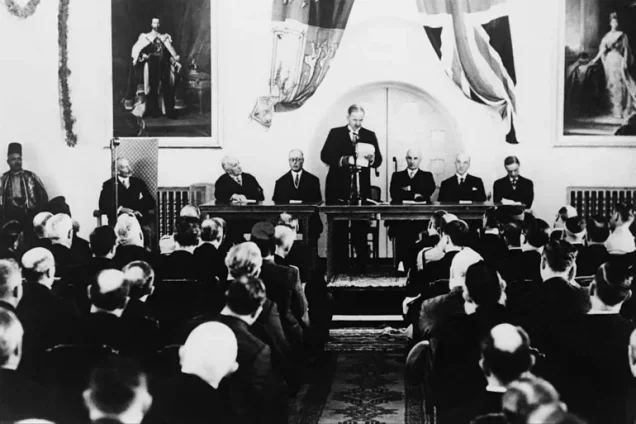
On July 7, 1937, the British Palestine Royal Commission, better known as the Peel Commission, published its report on the causes of the Great Palestinian Revolt of 1936–1939 and the future of British policy in Palestine.
The report marked a major turning point in the history of the Palestinian question. For the first time, an official British political body recommended the partition of Palestine into separate Arab and Jewish states and formally endorsed the possibility of establishing a sovereign Jewish state rather than merely a “Jewish national home.”
Even more consequential for Palestinians was the commission's proposal for the transfer of population from one proposed state to the other. Because hundreds of thousands of Palestinian Arabs would remain inside the territory assigned to the proposed Jewish state, the commission discussed their resettlement outside that territory and explicitly contemplated transfer that could be voluntary or otherwise.
Background to the Peel Commission
The British government established the Royal Commission in 1936 after the outbreak of the Great Palestinian Revolt, which challenged both British colonial rule and the expansion of the Zionist project in Palestine.
The revolt had been driven by deep Palestinian grievances: continued Jewish immigration, Zionist land acquisition, the displacement of Palestinian peasants, Britain's commitment to the Jewish national home, and the continued denial of Palestinian demands for national independence and representative government.
The commission was chaired by Lord William Peel. It arrived in Palestine in November 1936 and heard testimony from British officials, Palestinian leaders, representatives of the Zionist movement, and others before completing its inquiry in early 1937.
Although its original task was to investigate the causes of the revolt and examine how the Mandate was being implemented, the commission ultimately concluded that the Mandate had become unworkable and that Arab and Zionist national aspirations could not be reconciled within a single political framework.
Its proposed solution was partition.
The First Official British Proposal to Partition Palestine
The Peel Commission recommended terminating the existing Mandate and replacing it with a political arrangement that would create two sovereign states.
The proposed Jewish state would include much of Galilee, the Jezreel Valley, and a large section of the Mediterranean coastal plain.
The proposed Arab state would consist of the remaining Arab areas of Palestine and would be united with Transjordan.
Britain would retain control over a separate mandatory territory containing Jerusalem and Bethlehem, connected to the Mediterranean by a corridor extending through Lydda and Ramle toward Jaffa. The commission also proposed special British responsibilities for other religiously significant areas.
Jaffa itself, which the commission described as an essentially Arab city, was to form part of the Arab state.
The proposal therefore represented far more than an administrative rearrangement. It established for the first time in official British policy the principle that Palestine could be territorially divided in order to create a sovereign Jewish state.
The Palestinian Population Inside the Proposed Jewish State
Partition immediately created a demographic problem for the commission.
Large numbers of Palestinians lived within the territory that Britain proposed assigning to the Jewish state. The commission estimated that approximately 225,000 Arabs would live inside the proposed Jewish state's boundaries, excluding certain cities that were temporarily to remain under British administration.
By comparison, it estimated that only about 1,250 Jews would reside within the proposed Arab state.
Palestinian representatives challenged the demographic assumptions of the plan and argued that Arabs constituted a major, and in important districts predominant, share of both the population and private landownership within the territory allocated to the Jewish state.
This demographic reality led directly to one of the most controversial elements of the Peel Report: the proposal for transferring land and population between the two future states.
The Proposal for Population Transfer
The Peel Commission argued that simply drawing a border would not be sufficient to create what it regarded as a stable partition.
It therefore recommended an exchange of land and population between the proposed Arab and Jewish states.
The commission pointed to the compulsory population exchange between Greece and Turkey following the Greco-Turkish War as a precedent. Under that arrangement, more than a million people had been forcibly removed from the countries in which they lived and resettled according to religious and national categories.
In Palestine, however, the demographic imbalance meant that the proposed exchange would overwhelmingly involve the removal of Palestinian Arabs from the territory assigned to the Jewish state.
The report considered resettling Palestinians in Transjordan, the Jordan Valley, Beersheba, and other areas where British-sponsored irrigation and development projects might create additional agricultural land.
It initially expressed hope that Arab and Zionist leaders might agree to such an arrangement, but it also contemplated the possibility of transfer being carried out “voluntary or otherwise.”
The significance of this proposal was profound. An official British commission had placed the removal of a large Palestinian population from the territory designated for a Jewish state within the framework of a proposed political settlement.
“Transfer” Through a Palestinian Historical Lens
From a Palestinian perspective, the language of “transfer” obscured the human meaning of what was being proposed.
Palestinian families were not simply demographic units to be shifted between territories. They lived in towns and villages, cultivated agricultural land, owned homes and property, maintained religious institutions and cemeteries, and belonged to communities rooted in Palestine over generations.
Removing them in order to make the proposed Jewish state more demographically homogeneous would have meant uprooting Palestinians from their homes and transferring them to territory in which many had never lived.
Palestinian historians and scholars of settler colonialism therefore frequently treat the Peel Commission's transfer proposal as an important milestone in the history of ideas concerning the displacement of Palestinians.
The commission itself did not use the later term “ethnic cleansing.” Nevertheless, from a Palestinian historical perspective, its willingness to contemplate compulsory population transfer demonstrated that large-scale Palestinian displacement had entered official discussions about how a Jewish state could be created in a country where Palestinians remained the majority population.
The Palestinian and Arab Response
Palestinian political leaders rejected the Peel proposals.
The Arab Higher Committee submitted a memorandum condemning partition and insisting that Palestine could not legitimately be divided against the wishes of its inhabitants.
Palestinian leaders demanded an independent Palestine and argued that Britain had no right to allocate large parts of the country to a separate Jewish state.
They also emphasized that much of the land assigned to the proposed Jewish state remained Arab-owned and contained numerous Palestinian towns, villages, religious sites, agricultural lands, and communities.
Opposition to the report spread throughout Palestine and the wider Arab world, and the partition proposal contributed to the renewed escalation of the Great Palestinian Revolt during 1937.
The Zionist Response
The Zionist leadership had a different response.
It was divided over the Peel Commission's proposed borders and the relatively limited territory assigned to the Jewish state. Nevertheless, the Zionist movement recognized that the report represented a historic political breakthrough: for the first time, a major imperial power had formally endorsed the principle of Jewish statehood in Palestine.
At the Twentieth Zionist Congress, held in Zurich in August 1937, delegates did not accept the Peel map as presented, but authorized the Zionist Executive to continue negotiations with Britain on the basis of partition and the establishment of a Jewish state.
The principle of partition could therefore be treated by Zionist leaders as a basis for further political negotiations even while they sought different borders and more favorable territorial arrangements.
Britain's Response to the Peel Recommendations
The British government initially announced its general agreement with the arguments and conclusions of the Peel Commission and described partition as the most promising way out of the political deadlock.
Yet serious questions remained about whether the plan could actually be implemented.
Britain therefore appointed another body, the Woodhead Commission, in 1938 to examine the practical and financial feasibility of partition.
The Woodhead Commission concluded that the proposed partition arrangements were not workable in the form envisaged, and Britain subsequently abandoned the immediate Peel scheme.
The Peel plan itself was therefore never implemented.
From the Peel Commission to Later Partition Plans
Although the Peel proposal failed, the principle it introduced did not disappear.
Before 1937, British policy had officially spoken of establishing a Jewish national home within Palestine. The Peel Report crossed an important political threshold by recommending the creation of an actual Jewish state through territorial partition.
The idea of dividing Palestine subsequently remained part of international discussions over the country's future.
Ten years later, on November 29, 1947, the United Nations General Assembly adopted Resolution 181, recommending another partition of Palestine into Arab and Jewish states, with Jerusalem under a special international regime.
The 1947 plan differed substantially from the Peel proposal in both its boundaries and political framework, but the Peel Commission had helped establish territorial partition as an internationally discussed solution to the conflict in Palestine.
Transfer and the Road to the Nakba
The relationship between the Peel transfer proposal and the mass Palestinian displacement of 1948 remains an important subject of historical scholarship.
The Peel Commission did not itself create a policy implemented in 1948, and its partition scheme was abandoned. It would therefore be historically inaccurate to describe the report as a direct operational plan for the Nakba.
Its importance lies elsewhere: the report made the large-scale transfer of Palestinians an explicit subject of official political discussion in connection with establishing a Jewish state.
The proposal also intensified discussion of transfer within Zionist political circles. Some leading Zionist figures subsequently expressed support for compulsory transfer as a possible means of resolving the demographic problem created by establishing a Jewish-majority state in a country with a large Palestinian Arab population.
From a Palestinian historical perspective, this represents an important stage on the road toward 1948. Ideas that treated Palestinians as a population that might be removed from strategically desired territory preceded the mass displacement that took place during the Nakba.
The Historical Significance of the Peel Commission
The Peel Commission represents a critical turning point in modern Palestinian history.
It transformed partition from a theoretical possibility into an official British proposal. It transformed the idea of a Jewish national home into a formal recommendation for a sovereign Jewish state. And it brought population transfer into official discussions over the political future of Palestine.
For Palestinians, the report exposed a fundamental contradiction in British colonial policy: rather than recognizing the right of Palestine's majority population to national independence, Britain proposed dividing their homeland and relocating a substantial part of its Palestinian population in order to make the new territorial arrangement viable.
The Peel plan was never implemented, but the questions it raised—partition, demographic engineering, population transfer, sovereignty, land, and displacement—would return with even greater force during the final decade of the British Mandate.
In 1948, those questions ceased to be merely proposals on paper. The Nakba brought mass Palestinian displacement on a scale far greater than that contemplated by the Peel Commission, leaving hundreds of Palestinian towns and villages depopulated and creating a refugee population whose dispossession remains at the heart of the Palestinian question.
More from the archive


 Download Our Palestine App
The whole archive in the palm of your hand: depopulated villages, the Nakba, the massacres and Al-Aqsa — free, with no ads to erase the story.
Download Our Palestine App
The whole archive in the palm of your hand: depopulated villages, the Nakba, the massacres and Al-Aqsa — free, with no ads to erase the story.

Comments
No comments yet — be the first to write one.
Add your comment
Name and email are optional. Comments appear after review.