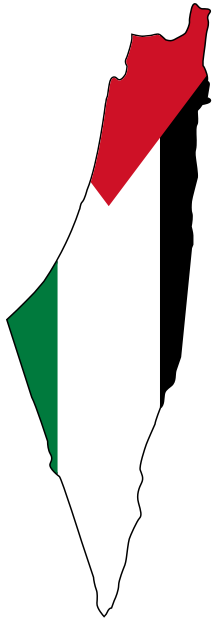
The First Zionist Congress in Switzerland and the Establishment of the Zionist Organization

The First Zionist Congress in Switzerland and the Establishment of the Zionist Organization
The First Zionist Congress, held in Basel, Switzerland, from August 29 to 31, 1897, marked a decisive turning point in the development of modern political Zionism. At Basel, nationalist, political, and settlement-related ideas and initiatives that had previously operated separately were brought together within an organized international political movement with a defined program, leadership, and institutional structure.
The congress was convened and led by the Austro-Hungarian journalist and writer Theodor Herzl, one of the most prominent founders of modern political Zionism. Its central objective was to work toward the establishment of a home for the Jewish people in Palestine secured under public law.
The Basel Congress acquired particular significance because it transformed Zionist aspirations concerning Palestine into an organized political program at a time when Palestine was already an inhabited country under Ottoman rule, with established Palestinian Arab towns, villages, and communities, as well as a deeply rooted economic and social life.
The Basel Program
The adoption of the Basel Program was one of the most important outcomes of the First Zionist Congress, as it formally defined the objective of the Zionist movement and the methods proposed to achieve it.
The program declared:
“The aim of Zionism is to create for the Jewish people a home in Palestine secured by public law.”
To achieve this objective, the Basel Program outlined four principal methods:
- The appropriate promotion of the settlement of Palestine by Jewish farmers, artisans, and tradesmen.
- The organization and unification of Jews through appropriate local and general institutions.
- The strengthening of Jewish national consciousness and identity.
- The taking of political and diplomatic steps necessary to obtain the consent of governments required to achieve the aims of Zionism.
These provisions demonstrated that Zionism was no longer limited to a cultural or religious attachment to Palestine. The movement now possessed a declared territorial objective and a strategy based on organized settlement, international political activity, institution-building, and negotiations with governments.
The Establishment of the Zionist Organization
The congress also established the Zionist Organization as the institutional framework of the international Zionist movement, and Herzl was elected its president.
The organization brought together Zionist associations operating in several countries and created a political structure through which the movement could coordinate its diplomatic, organizational, financial, and settlement-related activities.
In the years that followed, the Zionist movement established additional institutions devoted to financing immigration, purchasing land, supporting settlements, and building the economic infrastructure required for the project in Palestine.
Among these institutions was the Jewish National Fund, established during the Fifth Zionist Congress in 1901 to raise funds and purchase land in Palestine for Jewish settlement.
These institutions became increasingly important during the first half of the twentieth century and contributed to the creation of a separate and increasingly organized Jewish political, economic, and social infrastructure within Palestine.
From Basel to the Balfour Declaration
The First Zionist Congress did not immediately succeed in securing official support from a major European power. Obtaining international political recognition and governmental support for the Zionist project therefore became one of the principal objectives pursued by Herzl and the movement after the Basel Congress.
Twenty years later, on November 2, 1917, this effort achieved a major political breakthrough when the British government issued the Balfour Declaration, announcing that it viewed with favor the establishment in Palestine of a “national home for the Jewish people.”
The declaration represented a profound historical injustice, as Britain pledged its support for a national project in Palestine without recognizing the Palestinian Arab majority as a people possessing equivalent national and political rights to determine the future of their own homeland. The text of the declaration referred to the Palestinians as the “existing non-Jewish communities in Palestine,” without recognizing corresponding political or national rights.
Following the First World War, the principles of the Balfour Declaration were incorporated into the framework of the British Mandate for Palestine. The Mandate required Britain to place the country under political, administrative, and economic conditions that would facilitate the establishment of the “Jewish national home.” It also recognized the Zionist Organization as the Jewish Agency recognized at that stage for the purpose of cooperating with the Mandate administration, and provided for facilitating Jewish immigration and encouraging close Jewish settlement on the land.
For Palestinian society, these policies contributed to a fundamental change in the political balance within the country. British rule provided a political and institutional framework within which Zionist immigration, land acquisition, settlement, and Jewish national institutions expanded, while Palestinian demands for a national government based on the population’s right to self-determination remained unfulfilled.
Herzl’s Assessment of the Congress
Herzl himself was aware of the historical significance of what had taken place in Basel. Shortly after the congress, he wrote his famous words in his diary:
“If I were to sum up the Basel Congress in one sentence, I would say: At Basel I founded the Jewish State. If I said this aloud today, I would be met with universal laughter. Perhaps in five years, and certainly in fifty, everyone will recognize it.”
These words reveal the scale of the ambition Herzl associated with the congress. He did not regard Basel as merely another political meeting, but as the institutional beginning of a process ultimately intended to establish a state.
From the Basel Congress to the Palestinian Nakba
Over the following five decades, the process that had taken institutional form at Basel developed through settlement, diplomatic activity, British support, land acquisition, and the construction of increasingly powerful Zionist political, economic, and military institutions in Palestine.
Between 1947 and 1949, this project entered a decisive phase marked by the occupation of large parts of Palestine and the Palestinian Nakba. Around three-quarters of a million Palestinians were displaced from their towns and villages, hundreds of Palestinian communities were destroyed or emptied of their inhabitants, and the State of Israel was established in 1948 over most of Mandatory Palestine.
The Nakba was not merely a temporary military outcome; it brought about a profound transformation of Palestine’s demographic and political landscape. Most Palestinians from the areas that came under Israeli control were uprooted and turned into refugees and displaced persons, while the right of return and the Palestinian refugee question became central and enduring issues of the Palestinian cause.
More from the archive



 Download Our Palestine App
The whole archive in the palm of your hand: depopulated villages, the Nakba, the massacres and Al-Aqsa — free, with no ads to erase the story.
Download Our Palestine App
The whole archive in the palm of your hand: depopulated villages, the Nakba, the massacres and Al-Aqsa — free, with no ads to erase the story.

Comments
No comments yet — be the first to write one.
Add your comment
Name and email are optional. Comments appear after review.