The League of Nations Approves the British Mandate for Palestine and Incorporates the Jewish National Home into Its Terms
The League of Nations Approves the British Mandate for Palestine and Incorporates the “Jewish National Home” into Its Terms
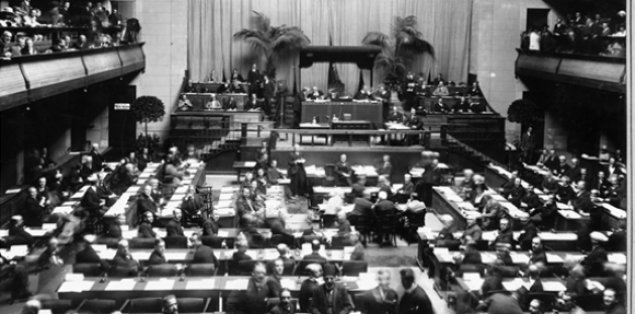
On July 24, 1922, the Council of the League of Nations formally approved the British Mandate for Palestine, granting Britain extensive legislative and administrative authority over the country.
The Mandate did not merely place Palestine under temporary British administration. It formally incorporated the Balfour Declaration of November 2, 1917 into an international instrument and assigned Britain responsibility for creating the political, administrative, and economic conditions necessary for the establishment of what the Mandate called a “Jewish national home” in Palestine.
The Mandate was approved in 1922, but formally entered into force on September 29, 1923.
This represented a decisive turning point. A commitment that had originally been issued unilaterally by the British government had now become part of a formal international system, despite the fact that the overwhelming majority of Palestine’s inhabitants were Palestinian Arabs and had not been consulted about the political and demographic project being devised for the future of their homeland.
The Mandate and the Balfour Declaration
The Mandate for Palestine consisted of a preamble and 28 articles. The preamble explicitly referred to the Balfour Declaration and stated that the Mandatory Power was responsible for putting the British declaration into effect.
Article 2 expressed this obligation clearly, stating that:
“The Mandatory shall be responsible for placing the country under such political, administrative and economic conditions as will secure the establishment of the Jewish national home.”
At the same time, the same article referred to the development of self-governing institutions and required Britain to safeguard the civil and religious rights of all inhabitants of Palestine regardless of race or religion.
However, the structure and language of the Mandate created a clear political imbalance. The Jewish people were explicitly recognized in the context of a national project, and the Mandate linked that project to an officially recognized Jewish institution, while the preamble referred to the Palestinian Arab majority as the “existing non-Jewish communities in Palestine.”
Their civil and religious rights were mentioned, but the document did not similarly recognize them as a people possessing national and political rights in their own country, nor did it explicitly affirm their right to self-determination.
The Jewish Agency and Zionist Institutions
Article 4 of the Mandate provided for the recognition of an appropriate Jewish agency as a public body responsible for advising and cooperating with the Administration of Palestine on economic, social, and other matters affecting the establishment of the “Jewish national home” and the interests of Palestine’s Jewish population.
The Mandate initially recognized the Zionist Organization for this purpose, so long as its organization and constitution were considered appropriate by the Mandatory Power. The expanded Jewish Agency for Palestine was formally established later, in 1929.
No comparable Palestinian Arab national institution was granted the same official status under the Mandate system.
This created an institutional imbalance at the heart of British rule. The Zionist movement possessed a formal and internationally recognized relationship with the governing authority, while the Palestinian Arab majority received no equivalent recognition as a national political community entitled to determine the future of the country.
Jewish Immigration and Settlement
Article 6 was among the most consequential provisions of the Mandate for the future of Palestine.
It required the Administration of Palestine to:
“facilitate Jewish immigration under suitable conditions.”
It also required the administration, in cooperation with the Jewish agency, to encourage:
“close settlement by Jews on the land, including State lands and waste lands not required for public purposes.”
The Mandate therefore did not provide for completely unrestricted Jewish immigration without regulation, as is sometimes claimed. It did, however, create an explicit international obligation for Britain to facilitate Jewish immigration and encourage Jewish settlement, while formally requiring at the same time that the rights and position of other sections of the population should not be prejudiced.
Article 7 went further, requiring Britain to enact a nationality law containing provisions facilitating the acquisition of Palestinian citizenship by Jews who took up permanent residence in Palestine.
Taken together, these provisions created a political, legal, and institutional framework through which Zionist immigration, settlement, land acquisition, and institution-building could expand during the Mandate period.
The Palestinian Majority and the Question of Political Rights
Palestine’s demographic composition illustrates the scale of the political contradiction created by the Mandate system.
According to the British census of 1922, Palestine had a population of approximately three-quarters of a million people. Muslims constituted around 78 percent of the population, Jews around 11 percent, and Christians around 9 to 10 percent, alongside several smaller communities.
Palestinian Arab Muslims and Christians therefore constituted the overwhelming majority of the country’s population, while Jews made up approximately one-tenth.
Nevertheless, the Mandate explicitly recognized a Jewish national project in Palestine, while addressing the Arab majority primarily in terms of protecting its civil and religious rights.
From a Palestinian perspective, this was one of the fundamental injustices of the Mandate system: the political future of a country with an overwhelming Arab majority was being reshaped through an international framework that supported the development of another national project without obtaining the consent of the majority of the country’s population.
From Ottoman Rule to the Mandate System
The British Mandate emerged in the context of the dismantling of the Ottoman Empire’s Arab provinces after the First World War.
Britain and France had already negotiated spheres of influence and control during the war through arrangements such as the Sykes–Picot Agreement of 1916. After the war, the mandate system divided large parts of the Arab East between the two colonial powers.
France received the mandates for Syria and Lebanon, while Iraq and Palestine came under British influence and rule. Transjordan was administered under the broader framework of the Palestine Mandate, but the provisions of the Mandate concerning the establishment of the Jewish national home were formally suspended there in 1922.
Palestine nevertheless occupied a distinct position within this colonial system, because its Mandate did not merely establish British administration but also contained a specific political commitment to facilitate the establishment of the “Jewish national home.”
British Rule and Palestinian Resistance
Throughout the Mandate period, Palestinian political movements repeatedly demanded representative government, independence, an end to or restriction of Zionist immigration, and protection of Palestinian land from transfer to settlement institutions.
These demands led to growing confrontation with both British colonial rule and the expanding Zionist project in Palestine.
Palestinian resistance took many forms, including petitions, political congresses, strikes, demonstrations, popular protests, and armed resistance.
Among the major turning points were the al-Buraq events of 1929 and the Great Palestinian Revolt of 1936–1939, which represented the largest Palestinian uprising against British rule and Zionist settlement before the Nakba.
Britain responded to the Great Revolt with extensive military force, imposing arrests, executions, collective punishments, curfews, and house demolitions, while working to dismantle a substantial part of the Palestinian political and military leadership.
The consequences of suppressing the revolt extended far beyond 1939. Palestinian society entered the decisive years preceding the Nakba politically and militarily weakened and with a divided leadership, while Zionist institutions had developed more organized and powerful political, economic, and military structures.
Immigration, Land, and Demographic Transformation
Jewish immigration increased substantially during various stages of the Mandate, particularly during the 1930s as the persecution of Jews intensified in Europe and the Nazi regime rose to power.
British immigration policy was not constant throughout the Mandate period. At different stages, Britain imposed quotas, restrictions, and policy changes, most notably through the White Paper of 1939.
Nevertheless, over the Mandate period as a whole, the Jewish population of Palestine increased dramatically, while Zionist institutions expanded their landholdings, settlements, economic networks, political structures, and military capabilities.
This demographic and institutional transformation was not separate from the political framework established by the Mandate, which formally obligated Britain to facilitate the establishment of the Jewish national home.
From the Mandate to 1948
By the end of the Second World War, Britain was facing an escalating crisis in Palestine amid Palestinian resistance, the growing activity of the Zionist movement and its armed organizations, and increasing confrontation with British forces themselves.
In 1947, Britain referred the question of Palestine to the United Nations. On November 29, 1947, the United Nations General Assembly adopted Resolution 181, recommending the partition of Palestine into an Arab state and a Jewish state, with Jerusalem placed under a special international regime.
Palestinians and the Arab states rejected the partition proposal, arguing that it violated the principle of self-determination because it allocated most of Palestine’s territory to the proposed Jewish state at a time when Palestinian Arabs remained the majority of the population and owned most of the country’s land.
Britain announced that its Mandate for Palestine would terminate at midnight between May 14 and 15, 1948.
On the afternoon of May 14, 1948, several hours before the British Mandate formally ended, the Zionist leadership proclaimed the establishment of the State of Israel, with the declaration taking effect upon the termination of British rule that night.
But the Palestinian Nakba had already begun before the end of the Mandate. Palestinian towns and villages had been attacked and depopulated, and tens of thousands of Palestinians had already been forcibly displaced from their homes. The process continued during the war, ultimately resulting in the displacement of around three-quarters of a million Palestinians and the destruction or depopulation of hundreds of Palestinian towns and villages.
From the British Mandate to the Palestinian Nakba
The period from the beginning of British rule to 1948 occupies a central place in Palestinian historical memory. Under British rule, Zionist immigration, settlement, and political, economic, and military institutions expanded, while Palestinian resistance was repeatedly suppressed and Palestinian national independence remained unrealized.
Between 1947 and 1949, the Zionist project entered a decisive phase marked by the occupation of large parts of Palestine and the Palestinian Nakba. Around three-quarters of a million Palestinians were displaced from their towns and villages, hundreds of Palestinian communities were destroyed or emptied of their inhabitants, and the State of Israel was established in 1948 over most of Mandatory Palestine.
The British Mandate thus ended in May 1948, but the political, demographic, and institutional consequences that had developed during its decades of rule did not end with it. From a Palestinian perspective, the Mandate represents a fundamental stage in the historical process that led to the Nakba, with its mass dispossession, forced displacement, refugeehood, and loss of land—consequences that remain at the heart of the Palestinian cause to this day.
More from the archive


 Download Our Palestine App
The whole archive in the palm of your hand: depopulated villages, the Nakba, the massacres and Al-Aqsa — free, with no ads to erase the story.
Download Our Palestine App
The whole archive in the palm of your hand: depopulated villages, the Nakba, the massacres and Al-Aqsa — free, with no ads to erase the story.

Comments
No comments yet — be the first to write one.
Add your comment
Name and email are optional. Comments appear after review.